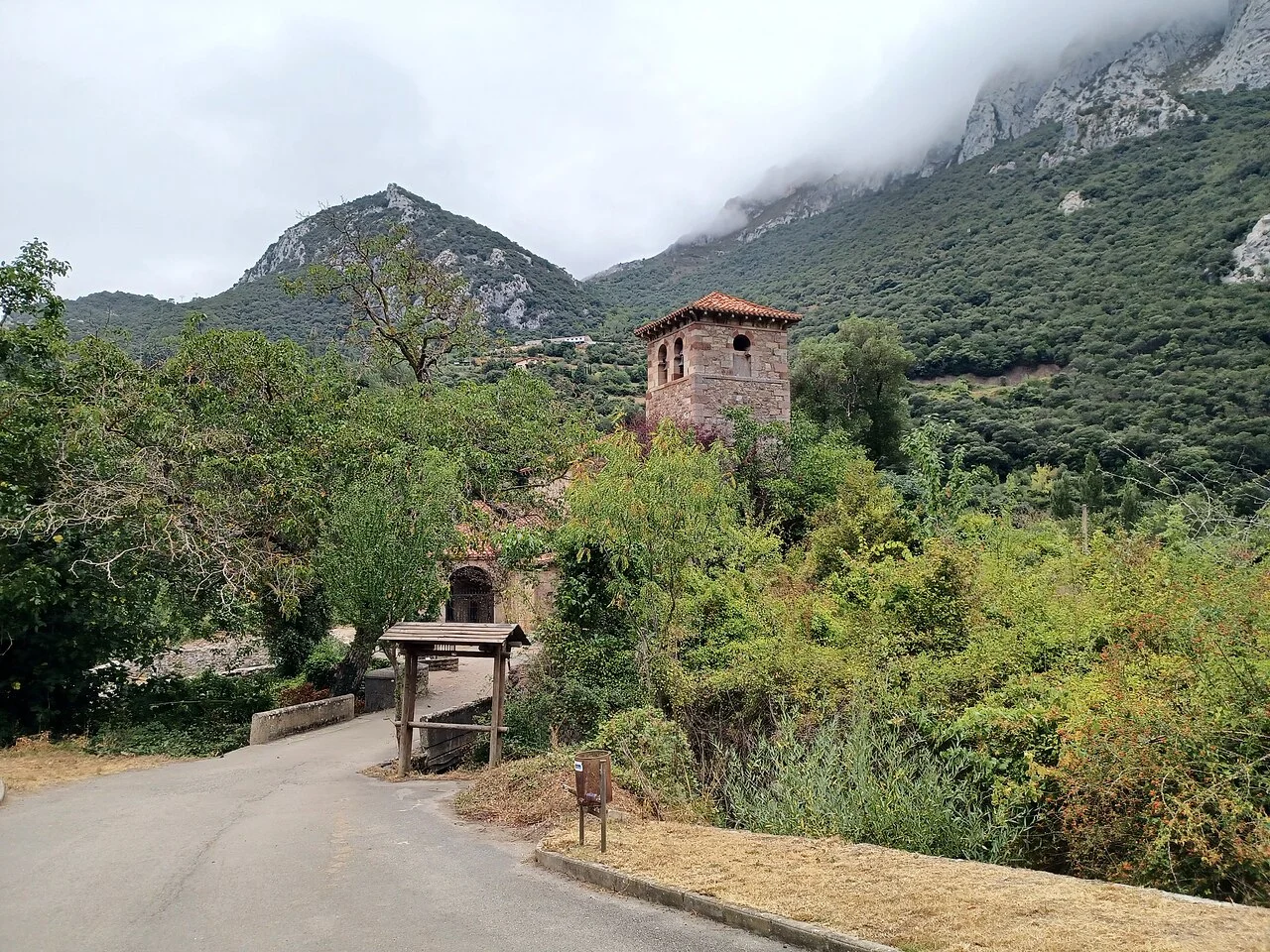
In a bend in the Deva valley, very close to the La Hermida gorge, Santa María de Lebeña preserves one of the most unique architectures in medieval Cantabria. Built in the 10th century, it combines horseshoe arches, composite pillars and a surprising set of vaults. For those who travel the Camino Lebaniego, the church is a stop where the history of the pilgrimage meets that of ancient monasteries and pre-Romanesque art.
The building does not impress with its size. From the road and from the path that descends from Cicera, the first thing that catches your attention is its integration into the landscape: small volumes of stone, tile roofs and mountains that close the horizon. But that exterior discretion does not anticipate the complexity of its interior.
The church belongs to the municipality of Cillorigo de Liébana and is located near the second official stage of the Lebaniego Road. It is not a monument isolated from the journey. It represents an essential part of the culture that emerged in Liébana long before the current routes were marked for pilgrims.
A church from the year 925 and a legend about Santo Toribio
Tradition places its foundation around the year 925 and links it to the counts Alfonso and Justa. In the cartulary of Santo Toribio there is a story that explains its relationship with the relics venerated in the Lebanese monastery. According to that story, the counts wanted to move the body of Santo Toribio to the new church, but they became blind when they tried to do so and regained their sight when they gave up.
It is a medieval legend, not an episode that can be presented as a proven fact. Its interest is different: it shows the importance that relics, religious authority and the link between places of worship had during those centuries. The narrative itself forever links Lebeña with Santo Toribio, the spiritual goal of the Lebaniego Way.
The 10th century was a time of great transformations in the north of the peninsula. In mountainous territories like Liébana, religious communities and small churches linked to powerful families, rural farms and communication networks developed before modern roads. Santa María de Lebeña allows us to contemplate one of the most outstanding material testimonies of that context.
The temple was recognized as a national monument in 1893, a precursor to its current heritage protection. At the end of the 19th century, a free-standing bell tower was added, more recent than the main building. The portico and the sacristy also correspond to later stages. Therefore, although today we see it as a whole, not all its parts were built at the same time.
Why its horseshoe arches make Lebeña a pre-Romanesque jewel
Upon entering, one discovers a church very different from the large Romanesque naves that pilgrims can see on other routes. The plan is rectangular, approximately 16 by 12 meters, with three naves and three parallel apses. The central nave is wider and higher than the lateral ones, although the whole maintains a small scale.
The supports constitute one of its main architectural contributions. The pillars have a square core and attached columns, a solution that anticipates procedures later common in Romanesque art. The capitals have Corinthian-inspired decoration, with plant shapes that should be observed slowly.
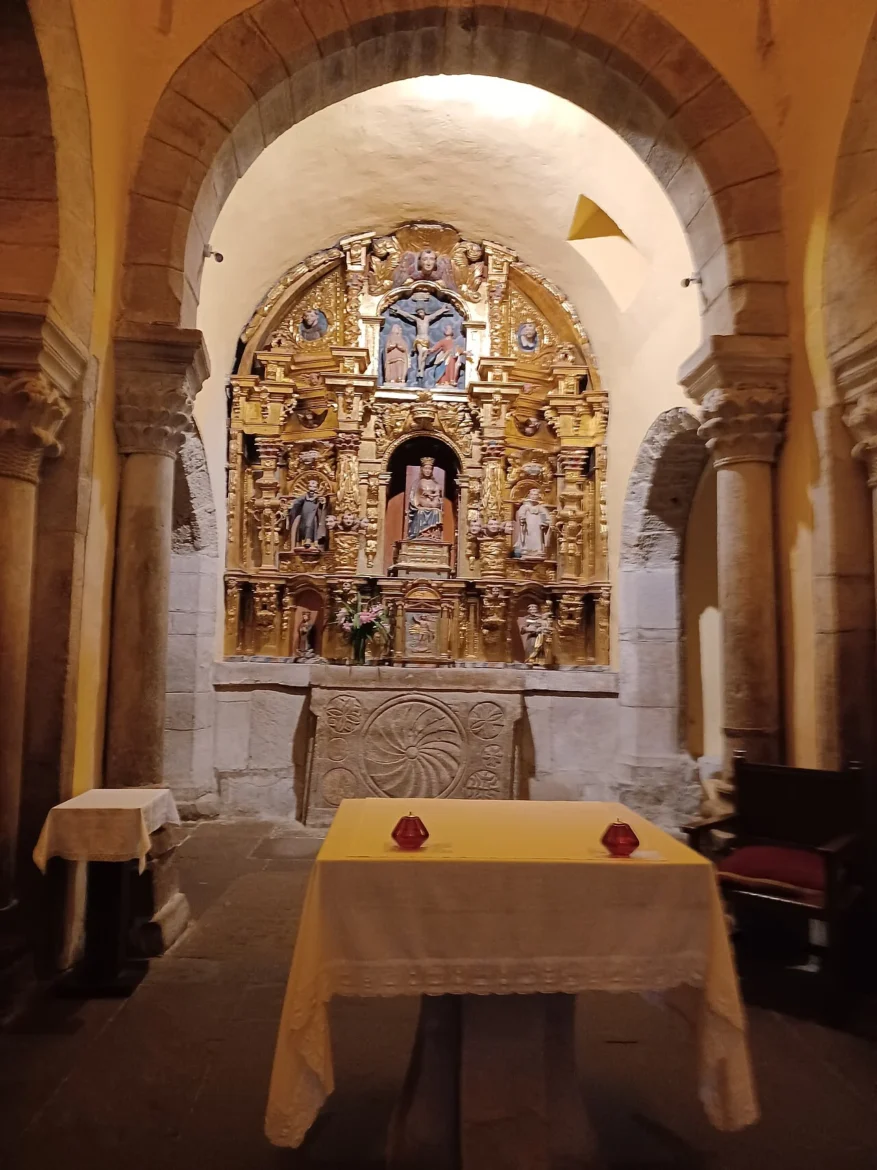
Horseshoe arches appear between the pillars, related to the artistic traditions of the time and Hispano-Muslim influences. The triumphal arch of the presbytery is also framed by an alfiz, an ornamental resource that reinforces its uniqueness. At the headers there are semicircular arches, so that different formal solutions coexist.
The interior cover offers another architectural lesson. The barrel vaults are not all arranged in the same direction: in some areas they are oriented longitudinally and in others transversely. This organization helps to distinguish the spaces, distributes the loads and shows the technical mastery of those who built the church.
The term "Mozarabic" has traditionally been used to describe it, although there is also talk of repopulation art and influences from Asturian architecture are recognized. These names respond to debates in art history. For the visitor, what is relevant is to observe the concrete solutions that the building preserves and understand that medieval art did not develop in closed compartments.
The front of the altar and the Virgin of Good Milk
Inside, an ancient sandstone altar front stands out, carved with a composition of circles and geometric motifs. Its design does not need large dimensions to attract attention: it invites you to imagine how the liturgical space was organized in a small church of the 10th century.
The decoration includes a main circle surrounded by other circular and radial motifs. Studies on the temple have proposed symbolic interpretations related to light, the order of the world and Christian beliefs. It is convenient to distinguish these readings from the material elements that can really be observed: the piece, its shapes and its carving traces.
The altarpiece is later, from the Baroque period. It is home to the well-known Virgin of Good Milk, also called the Virgin of Bethlehem, a 15th century Gothic carving that represents Mary breastfeeding the Child. The image adds another artistic era to the small sanctuary.
The carving also starred in a recent episode in its history: it was stolen in 1993 and recovered by the Civil Guard in 2001, along with other works of sacred art. The fact reminds us that the protection of a monument does not end with the conservation of its walls; It also affects the pieces it guards and the cultural memory they represent.
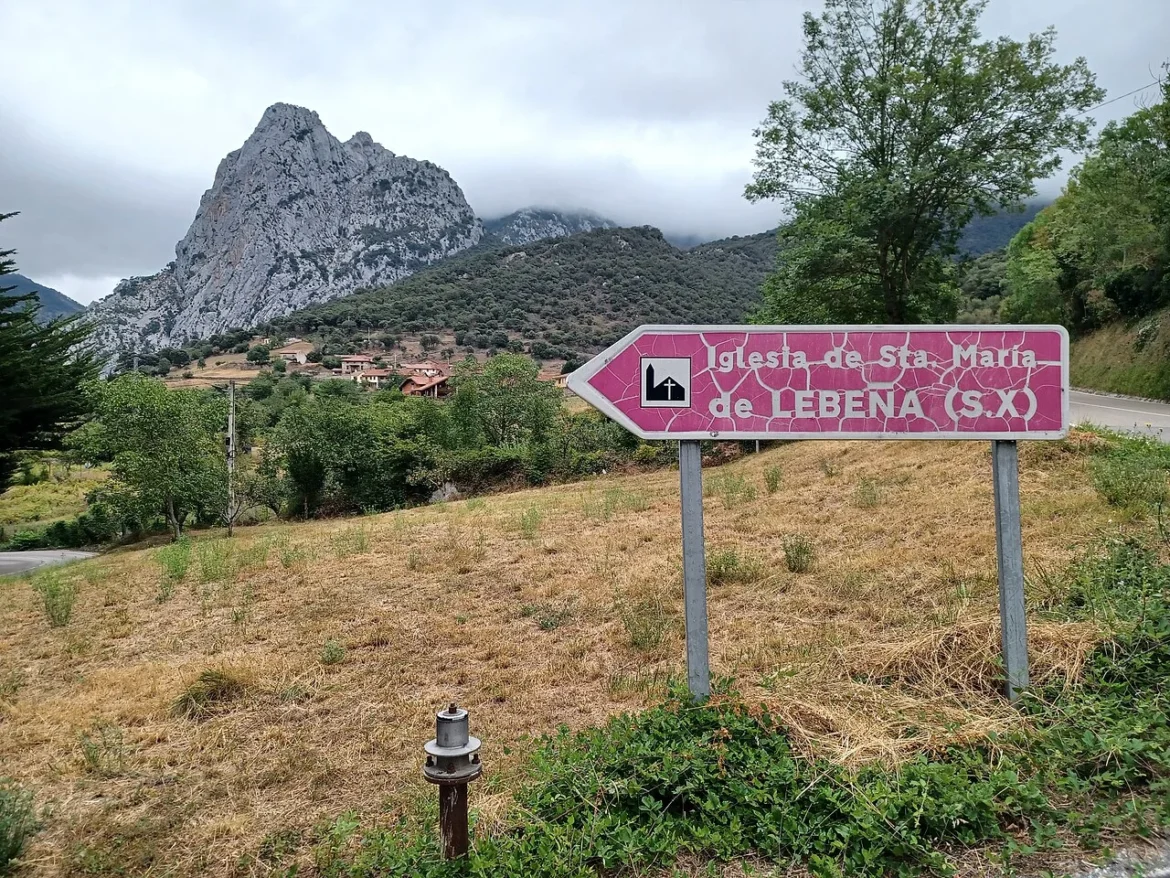
A medieval church surrounded by the landscape of Liébana
The exterior allows us to recognize the volumes of the three naves, the different levels of the roofs and the sobriety of the walls. The masonry is combined with ashlars in structural areas, and carved modillions appear under the cornices. Some reproduce geometric motifs and six-petal flowers.
The porch and sacristy, incorporated in the Baroque period, modified the appearance of the temple without erasing its medieval character. The free-standing bell tower, built in the 19th century, usually appears in the best-known photographs and helps to recognize the complex from a distance.
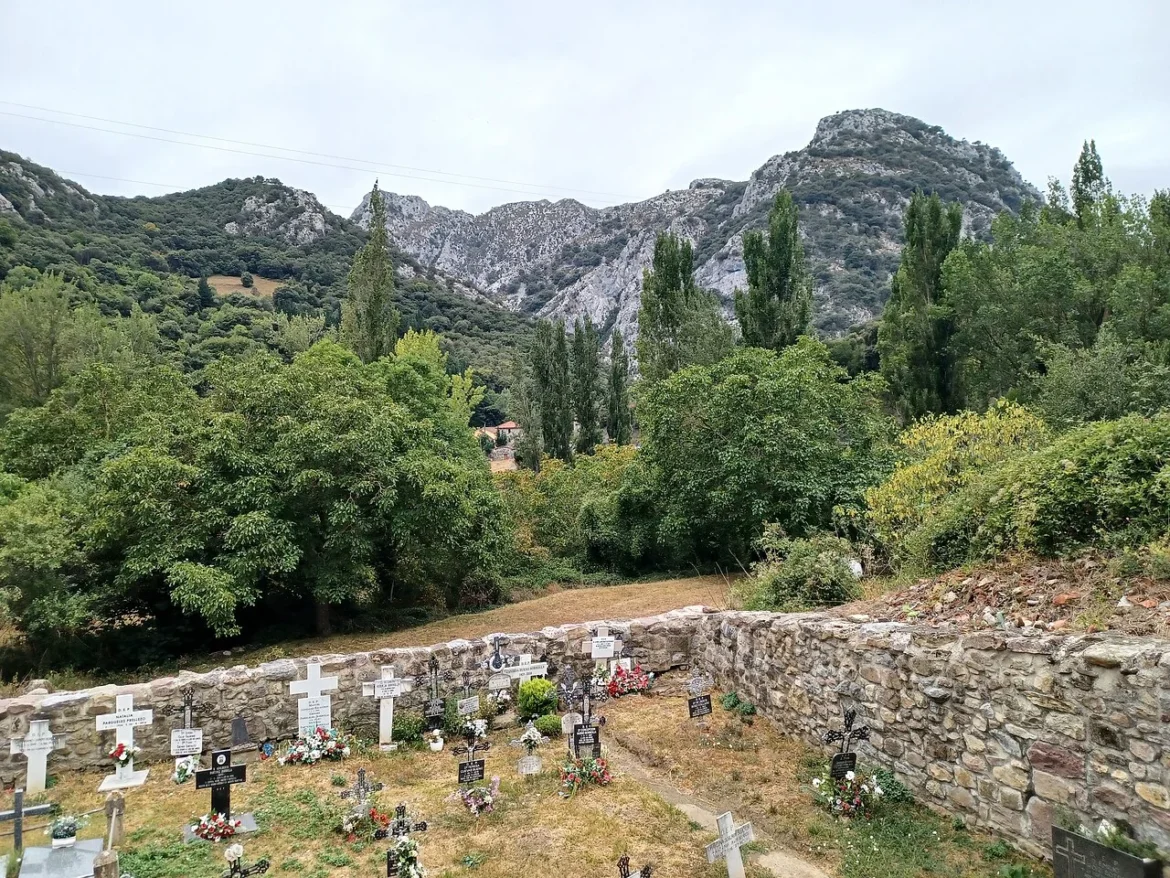
The church also maintains a close relationship with its immediate surroundings: the cemetery, the paths, the trees and the rocky wall of the valley. Its location explains part of its appeal. Santa María was not built to dominate a large urban plaza, but to serve a community in a place where communications always depended on the relief.
For pilgrims, the stop offers an interesting contrast to the day. Whoever has descended from Cicera can find a moment in Lebeña to stop before facing the climb through Allende towards Cabañes. It is not advisable, however, to improvise access or forget that it is a temple with religious use and visiting rules.
How Santa María de Lebeña fits into the second stage of the Camino Lebaniego
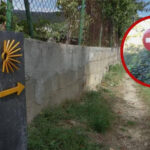
The official stage between Cades and Cabañes crosses different valleys and hills. From Lafuente it ascends towards Burió and the Hoz hill, then descends towards Cicera and continues through forests and paths that lead to the surroundings of Santa María de Lebeña. The next part of the route passes through Allende and gains height until Cabañes.
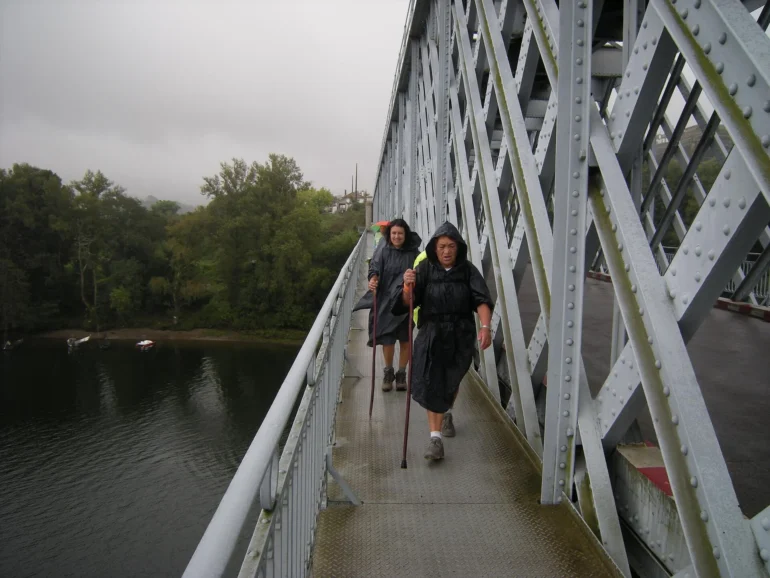
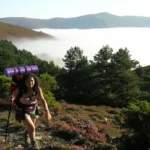
It is a demanding day. If you want to visit the church inside, check the opening and leave enough room to continue later. Mountain trails can be slippery in rain and connections near N-621 require attention to signage and traffic.
The Lebeña profile from the RTV Viva Guide It gathers information about the town, the continuity of the Camino and the contact information for visitors. The monumental report complements this file: it offers a more leisurely reading of the arches, the capitals, the altar and the history of the temple.
This relationship between route and heritage helps to understand that the Camino Lebaniego is not only a succession of stages. It passes through places that preserve memories of the ways of life, beliefs and construction techniques of different eras. In Lebeña, that memory is seen in stone.
Schedules, tickets and tips for visiting Santa María de Lebeña
Institutional documentation indicates that there is a guided tour service, although its hours and periods of service vary throughout the year. Therefore, it is not prudent to ensure a single schedule for all dates. The City Council of Cillorigo de Liébana provides the telephone 647 405 894 for visitor information. The Camino Lebaniego Foundation directory also offers the telephone number 942 840 317 to check conditions.
Before you go, confirm the opening, the current rate, if there will be a guided tour and if photographs are allowed. During religious celebrations, tourist visits may be suspended. Respect spaces of worship, avoid touching historical items, and check backpack and group rules.
If you do the stage on foot, remember that the visit may alter your arrival time in Cabañes. It is advisable to bring water and check in advance the accommodation where you will spend the night, especially in high season or when the weather is unstable.
Santa María de Lebeña is one of those monuments that reward a careful look: a small building, built more than a thousand years ago, that preserves some of the keys to understanding the medieval architecture and cultural history of the Camino Lebaniego.
Photo credits and documentation
Photographs of the church of Santa María de Lebeña (01, 03, 06 and 08): Simon Burchell, Wikimedia Commons, license CC BY-SA 4.0. Images resized and optimized for RTV . The featured image is not repeated inside the article.
Sources: Camino Lebaniego Foundation, Santa María de Lebeña; history and architecture of the temple; Cillorigo de Liébana Town Hall.