Foot pain does not give a big warning. It starts as a slight rub on your heel, a hot spot under your big toe, or that feeling that your sock has wrinkled. Ignoring it can turn a beautiful stage into a battle. Know how to avoid blisters on the Camino de Santiago It is not about buying the most expensive material: it is about observing your feet, anticipating friction and acting before the skin breaks.
A blister can force you to cut miles, take a taxi or arrive at the hostel with your spirits in tatters. But it is not an inevitable toll of the pilgrimage. With preparation, smart breaks, and a small first aid kit within reach, most can be prevented. Your feet are your transportation to Santiago: treat them as such!
How to avoid blisters on the Camino de Santiago from the first day
Prevention begins at home, not in Sarria, Roncesvalles, Tui or Irún. The classic mistake is to wear new boots because “they are specific for the Camino”. Excellent shoes without breaking in can be a problem. It should be used on progressive walks, with the socks that you will carry in the backpack and with some weight on top.
It is not necessary to travel a hundred kilometers before leaving, but you do need to accumulate several outings of between 8 and 15 kilometers. This way you will detect if the heel rises, if a toe hits the toe on descents or if a seam rubs. Each foot has its map and it is advisable to know it before the first yellow arrow.
Choose shoes by fit, terrain and time of year. On the Camino Frances during spring or fall, a trekking shoe with good support usually works very well for many people. On the Camino del Norte or Primitivo, with frequent mud, stones and rain, you may prefer a light boot that stabilizes the ankle more. In the middle of summer, perspiration weighs heavily in the decision: a foot soaked in sweat macerates and blister sooner.
The size deserves attention. Leave approximately one finger of margin in front of the longest, especially if you will do stages with descents. The foot swells after hours of walking and a perfect fit in the morning can become unbearable by midday. Don't buy too big either: the movement inside generates friction. Try on both shoes in the late afternoon, when your foot is most dilated, and walk around the store in them.
The sock is not a minor detail
Cotton socks retain moisture and are usually bad company for long days. Look for technical fabrics, merino wool or synthetic fibers that wick away sweat and have few seams. Not all models suit all pilgrims: some need thickness and padding; others, a thin sock so as not to squeeze the shoe.
The double sock system can help if you know what works for you. The idea is that the friction occurs between the two layers and not against the skin. However, if your shoe already fits snugly, adding bulk will make the pressure worse. Do the test before the Camino, never during a 25 kilometer stage.
Carry at least one clean, dry pair accessible during the day. Changing your socks after an intense climb, after rain or at the food stop can save the day. Take the opportunity to remove the insoles, air out the shoes and check the sole, sides and heels.
Humidity is the great ally of the blister
The combination of heat, sweat, rain and miles softens the skin. That's why it's a good idea to dry your feet very well after showering and not put on wet socks “just to finish.” On hot days, some pilgrims use specific powders or an anti-friction cream; others prefer Vaseline. Both options can work, but you have to try them: an excessive amount of product can cause the foot to slip inside the shoe.
Anti-chafing creams are applied before starting, especially on the heels, base of the toes and areas that you already know are sensitive. Vaseline reduces friction, but can alter the feel of the fit and stain the fabric. There is no universal formula. On the Camino, the best strategy is the one you have rehearsed and allows you to walk without paying attention to every step.
Check your feet before they hurt
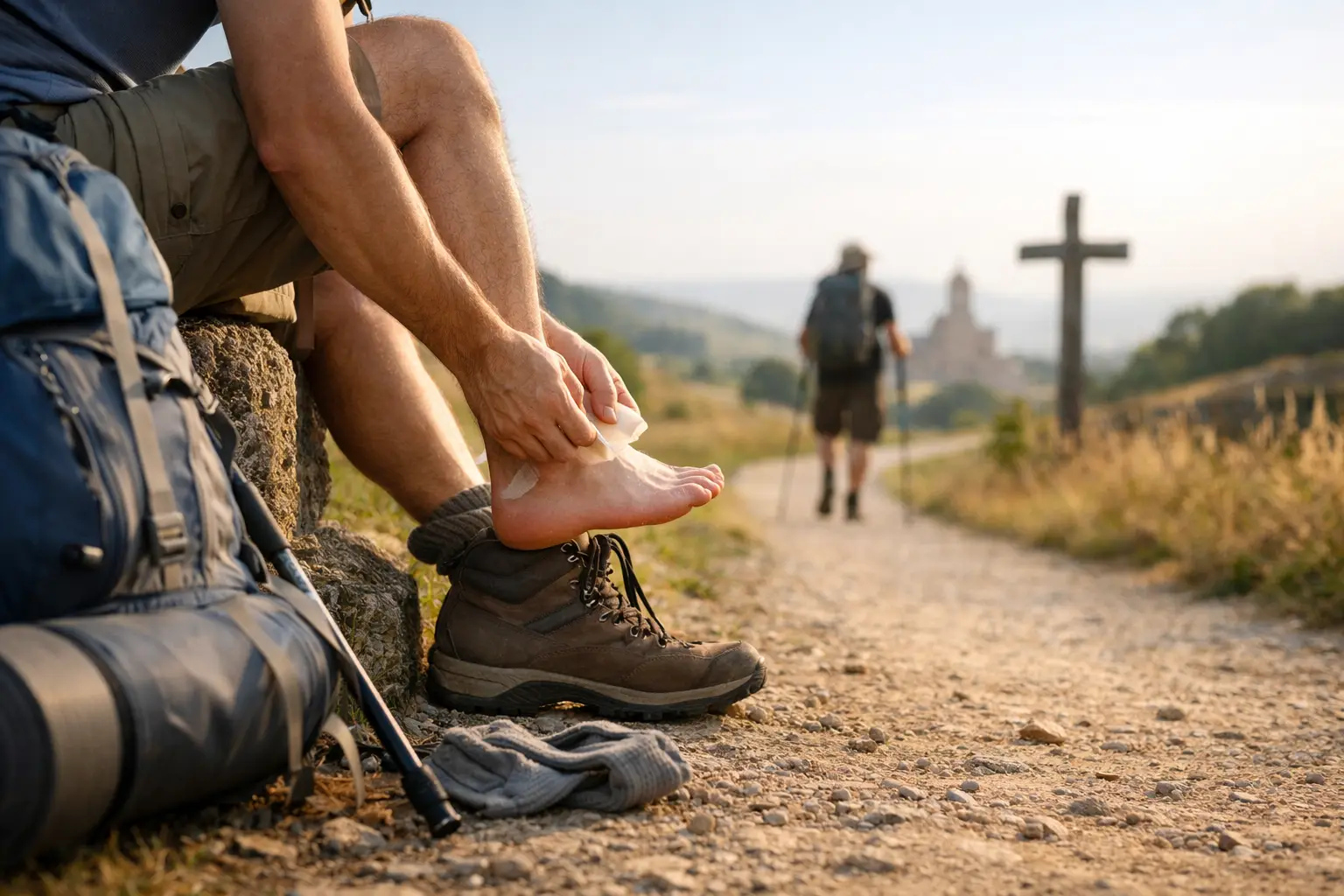
The key word is “hot spot.” It is a localized area that repeatedly burns, itches, or bothers even though there is not yet a visible blister. Stop as soon as you notice it. Five minutes sitting in the shade is much cheaper than three days of walking lamely.
Take off your shoe, dry the area and look for the cause: a small stone, a crease in the sock, a long nail, a displaced insole or a lace that is too tight. If you identify the spot, protect it with a preventive dressing, appropriate skin tape, or a specific protector. The protection must be smooth, without wrinkles or edges that generate new friction.
Don't wait for the official stop or the bar in the next town. On the long stages of the Vía de la Plata, for example, services can be separated by many kilometers. On the busiest routes it is not advisable to continue by inertia so as not to lose your group. The Camino is not won by arriving first at the hostel.
Adjust the laces according to the profile of the stage
Poorly adjusted laces cause slipping. On an uphill climb, excessive closure can compress the instep and impair circulation. On a descent, if the foot goes forward, the nails and fingers suffer. It is a good idea to learn a heel lock adjustment or use the extra eyelet on your shoe if it has one.
Make small changes and observe. Loosen up slightly when starting an uphill slope and secure the heel more before a long descent. It is a simple gesture that is especially noticeable in stages with unevenness, such as those of the Camino Primitivo or some mountainous sections of the Francés.
If a blister appears, act calmly
A small, closed, painless blister is usually protected and left intact. Wash your hands, clean and dry the area, cover it with an appropriate dressing and eliminate the friction that caused it. Walking with a blister without changing anything about your shoe or sock is giving it permission to grow.
When it is large, very tense or prevents support, treatment requires more care. Piercing it on your own increases the risk of infection, especially in unhygienic conditions. If you decide to do it out of necessity, use sterile material, preserve the skin that covers the injury, disinfect and protect it afterwards. It is prudent to ask for help from a health professional, pharmacy or health center in the municipality where you are.
Never ignore warning signs: spreading redness, intense heat, pus, fever, increasing pain, or red lines around the wound. People with diabetes, circulatory problems, neuropathy or low defenses should consult any foot injury and avoid improvised remedies. One less stage does not ruin the Camino; A poorly treated infection can really complicate it.
The first aid kit that deserves to be at hand
You don't need to carry half a pharmacy, but you do need to carry the essentials in an accessible pocket of your backpack. Includes dressings for blisters of various sizes, sterile gauze, tape to fix protections, suitable disinfectant, a small scissors or nail clippers and spare socks. Add the cream that you have already tried in training.
Hydrocolloid dressings soothe and protect very well in many cases, although they are not magical. On very wet skin they can peel off, and removing them too soon can damage the area. Place them on clean, dry skin, and let them do their job. If the edge begins to peel away, reinforce it with tape without completely covering the necessary ventilation.
In the afternoon, when you arrive at the hostel, don't immediately hide your feet in flip-flops. Wash them, dry them carefully, check the pressure areas and let them breathe for a few minutes. Cutting your nails straight and not too close also prevents bumps and ingrown toenails. Recovery begins at the end of the stage.
Walking wisely also protects the skin
Sometimes the problem is not in the boot, but in the plan. Wanting to do 30 kilometers on the first day, in the heat, with a heavy backpack and little training, multiplies the risk. The skin needs to adapt to the repetition and fatigued muscles modify the step. When we walk exhausted, we drag our feet more and brush where we didn't brush before.
Start with acceptable stages, listen to your body and reserve energy for the last kilometers, which are usually the most neglected. Drink water regularly, eat enough, and rest when necessary. There is no right distance for everyone: it depends on age, training, weather, pack weight and terrain.
On the Camino de Santiago RTV we see it again and again in conversations with pilgrims: whoever stops in time usually continues; Those who endure pain out of pride end up having to stop more. Walk lightly, check your feet and don't be afraid to ask advice from hospital workers, pharmacists or fellow travelers. Santiago will still be there tomorrow, and arriving with your feet whole will allow you to enjoy everything that happens between one stage and the next.