Canticum Novum will perform this Tuesday at the Citadel of Jaca with a show that connects the music of the Mediterranean, the East and Spain of the three cultures within the International Festival on the Camino de Santiago
He Camino de Santiago will demonstrate again this Tuesday that it is much more than kilometers, backpacks and yellow arrows. The historic city of Pony, one of the great entry points of the French Way through Aragon, will host one of the most special proposals of the International Festival on the Camino de Santiago 2026: the Canticum Novum concert, a group that uses music to travel through centuries of encounters between peoples, religions and cultures.
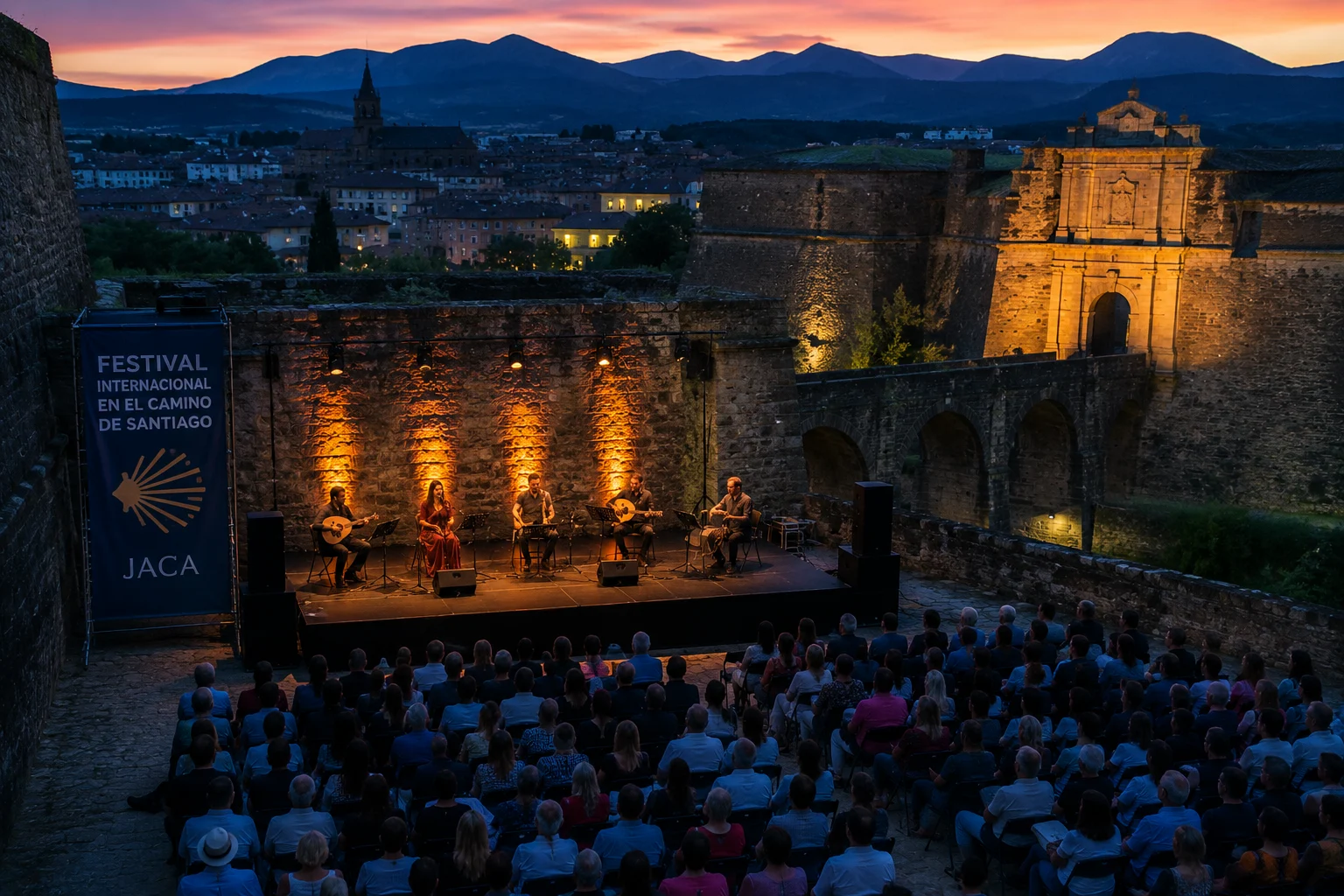
The performance will take place this Tuesday, August 11 at 10:30 p.m. in the Citadel of Jaca, one of the most spectacular monumental settings in the city. Canticum Novum will present Paradise. In the shadow of the gardens of the East, a program that recovers Mediterranean music and repertoires from Afghan, Turkish, Persian, Arab, Sephardic, Armenian and Cypriot traditions.
This is not just another summer concert. The proposal fits especially well with the history of the Camino de Santiago itself, a route that for centuries functioned as an enormous European corridor along which not only pilgrims traveled, but also merchants, artisans, ideas, artistic styles, languages and music.
A different night for pilgrims passing through Jaca
For pilgrims who are beginning the Aragonese Way these days, the coincidence can become one of those unexpected gifts that end up being remembered long after arriving in Compostela. After a day walking through Pyrenean landscapes, you will be able to encounter instruments and melodies at night that evoke precisely that world of cultural exchanges that existed when the great medieval pilgrimages were transforming Europe.
On stage they will be Emmanuel Bardon, responsible for musical direction; Gülay Hace Toruk, voice; Spyros Halaris, with kanun, lute and song; Aliocha Regnard, with nyckelharpa and fidula; and Henri-Charles Caget on percussion. The group's philosophy consists precisely of placing the human encounter and interculturality at the center of its projects and exploring concepts such as memory, oral transmission and identity.
And there appears a particularly beautiful connection with the Camino. A medieval pilgrim could encounter during his journey people who spoke completely different languages, listened to unknown music and crossed territories whose customs were new to him. Eight hundred years later, the Jaca concert will recover part of that enormous cultural mosaic.
From the Mediterranean to the Silk Road without leaving Jaca
The Canticum Novum repertoire crosses the Spain of the three cultures with the Mediterranean, the Silk Road and the former Ottoman Empire. They are music born from the encounter between civilizations that, despite the passage of centuries, continue to transmit a surprising sensation of relevance. The group's own approach uses that heritage to talk about diversity, respect and coexistence.
Canticum Novum was created by Emmanuel Bardon in 1996 and is currently linked to the Saint-Étienne Opera-Theater, in France. His career has specialized in building bridges between early music and world music, a philosophy especially appropriate for a festival that is celebrated precisely around one of the great cultural routes of Europe.
The Camino can also be heard
The performance is part of the 35th edition of the International Festival on the Camino de Santiago, which this summer is touring fourteen towns in the province of Huesca. The 2026 edition has as its motto “Paths in the sea” and focuses a good part of its programming on the musical life of the Mediterranean and the historical territories of the Crown of Aragon.
Until August 21, groups such as Enrike Solinís & Euskal Barrok Ensemble, Bachcelona Consort, Chiavette, Schola Cantorum Paradisi Portae, La Tendresa and Capella de Ministrers will perform at the festival, in addition to other cultural proposals related to cinema, theater and heritage.
The result during these weeks turns the Huesca territory into something similar to what the Camino itself was for centuries: a meeting point between people from very different places.
Because perhaps we tend to think of the Camino de Santiago only as a route that is traveled with our feet. However, a good part of its historical importance was born precisely from everything that traveled with the pilgrims. Ideas crossed borders. The Romanesque spread. Stories, knowledge and traditions circulated. And the music also traveled.
This Tuesday, when night falls over the Citadel of Jaca and instruments from very different traditions begin to play, the Camino will again for a few hours look very similar to that of centuries ago.
A place where people from different worlds meet, listen to each other and continue the journey together.