



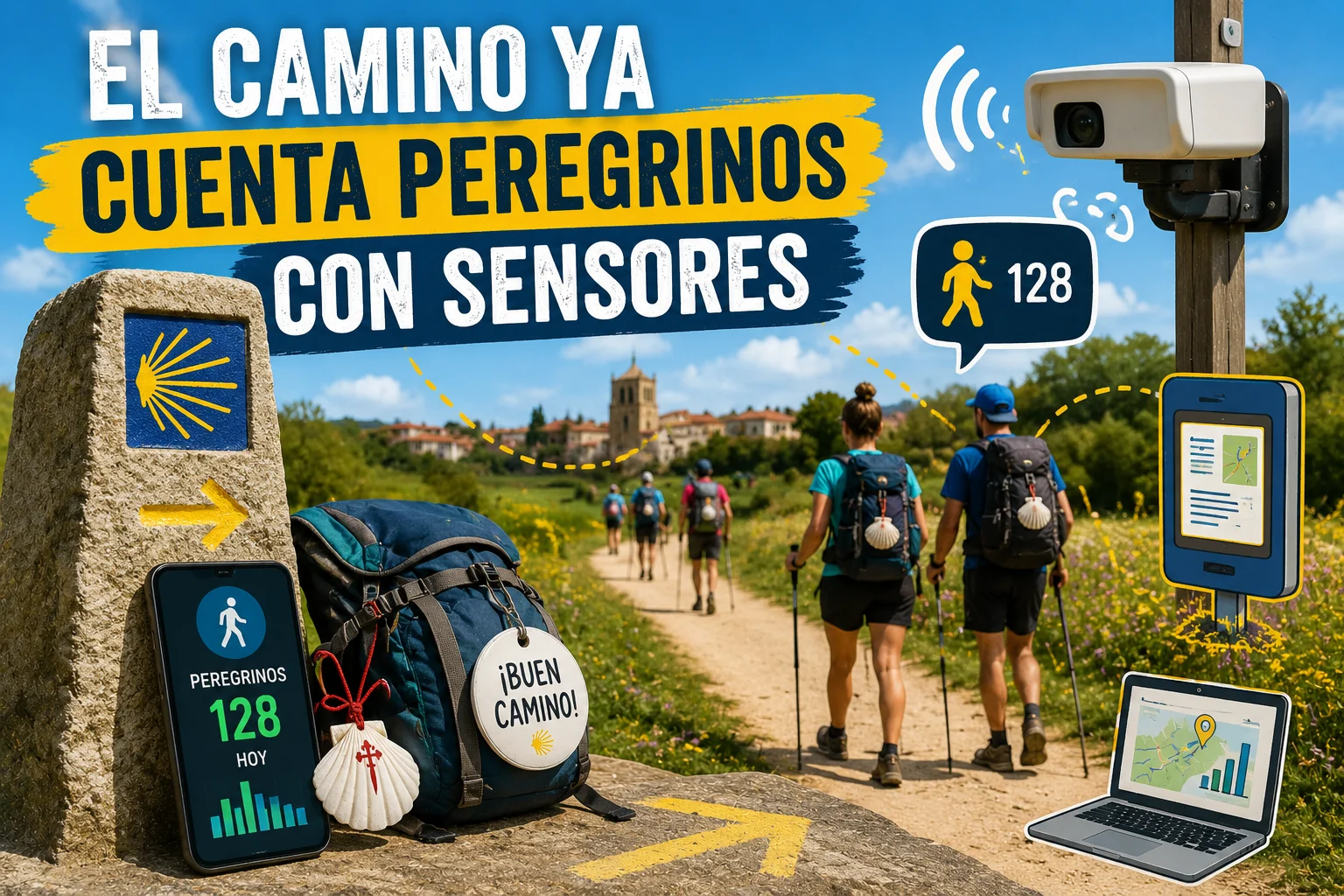
The Camino de Santiago takes a new step towards its digital transformation. Palencia has deployed interactive totems, systems capable of counting the passage of pilgrims and a new tourist portal to better understand what really happens on the route and offer information to walkers during their journey.
For centuries, to know how many pilgrims passed through a town on the Camino, you had to observe the path, ask at the hostels or wait to find out the numbers of arrivals in Santiago. Now, at certain points of the French Way in Palencia, the technology will allow us to obtain a much more precise photograph of these movements.
The Provincial Council of Palencia has completed different digitalization actions within its Tourism Sustainability Plan for the Camino de Santiago Destination, financed with NextGenerationEU European funds. Among the new features are interactive totems in Itero de la Vega, Frómista and Carrión de los Condes, in addition to sensorization systems intended to count the flows of pilgrims.
Know how many pilgrims actually pass
This is probably the most interesting part of the project.
Sensorization will allow information to be obtained about the movement of people and bicycles through certain points of the Camino. The technical project included cameras with artificial vision capable of distinguishing and counting both types of users, processing the information directly on the devices.
What is the use of counting pilgrims?
Much more than to obtain a curious figure.
Knowing the real flows can help to know when there is greater pressure on certain sections, anticipate needs, distribute resources and better understand the behavior of those who travel the Camino.
The Provincial Council itself proposes technology as a tool to understand and improve the management of pedestrian and bicycle mobility, in addition to contributing to security.
Interactive totems in the middle of the Camino
The second change will be much more visible to the pilgrim.
Itero de la Vega, Frómista and Carrión de los Condes They have interactive totems designed to provide tourist and cultural information during the tour.
We are not just talking about a traditional poster.
The project includes touch devices that allow you to browse content and consult information. The previous documentation even included a multilingual chatbot based on artificial intelligence, fed with official sources, to allow interaction with the visitor.
That is to say, the pilgrim who for centuries asked the hospitalkeeper, the neighbor or the priest what he could find a few kilometers ahead now begins to live with another possibility:
ask a machine located next to the Camino.
A new Camino also on mobile
The action also incorporates the digital portal Camino de Santiago Palencia, designed to gather tourist and cultural information and also content related to astrotourism. The whole of this digitalization action has meant an investment of 100,390.07 euros.
Portal Camino de Santiago Palencia
The objective goes beyond promoting monuments. The aim is to build a more intelligent tourism management model, where the information collected allows us to better understand the visitor and improve their experience.
Technology also to protect the pilgrim
Palencia has been introducing technology at other points along the route for months.
At several intersections of provincial roads with the Camino, intelligent systems have been installed with sensors capable of detecting vehicles and pedestrians. When they identify a potential risk situation, LED signaling alerts both drivers and pilgrims.
The rest area has also been improved. Itero de la Vega, with an investment of 47,190 euros destined, among other actions, to make it more accessible and improve its pedestrian connection with the urban area.
Digitization, therefore, does not only mean screens.
It can also mean data, prevention and security.
From the medieval pilgrim to the digital pilgrim
And here a much deeper transformation appears.
Today's pilgrim may carry the Credential in his pocket, but he also carries GPS, applications, accommodation reservations, automatic translation, maps, social networks and permanent access to information.
Now the territory itself is also beginning to become digital.
Sensors that know when a walker passes by. Signs that detect vehicles. Totems that answer questions. Platforms that show what to visit.
The Camino preserves stones, churches, yellow arrows and centuries-old traditions, but on them begins to build a new invisible layer formed by data and technology.
It will not replace a conversation with a hospitalero or the advice of another pilgrim.
But it is changing the way inform yourself, orient yourself, protect yourself and make decisions while walking towards Santiago.
Perhaps we are witnessing the birth of something that in a few years will seem completely normal to us:
the digital pilgrim's way.

















