
It is with great sadness that the Jacobean world has received the news of the death of José María Ballester, after a long illness that did not prevent him from attending what would be his last public event at La Granja de San Ildefonso at the end of last January. At the Royal Site, he received a tribute from Queen Sofía at the Hispania Nostra Awards for Good Practices in Cultural and Natural Heritage.
A person closely linked to the world of art, he worked in his professional beginnings in various newspapers, in charge of the field of culture and heritage, until he obtained a place in the Council of Europe that allowed him to develop his ideas about heritage in that organization. A highly recognized work that led him to occupy the position of Director of Culture, Cultural and Natural Heritage of the Council of Europe.
It would be at this time when his working relationship with the Camino de Santiago began, and which was strengthened with the arrival of Marcelino Oreja to the General Secretariat of the Council of Europe (1984-1989). It can be said that they are responsible for the recognition in 1987 of the Camino de Santiago as the First European Cultural Itinerary approved by the Council of Europe.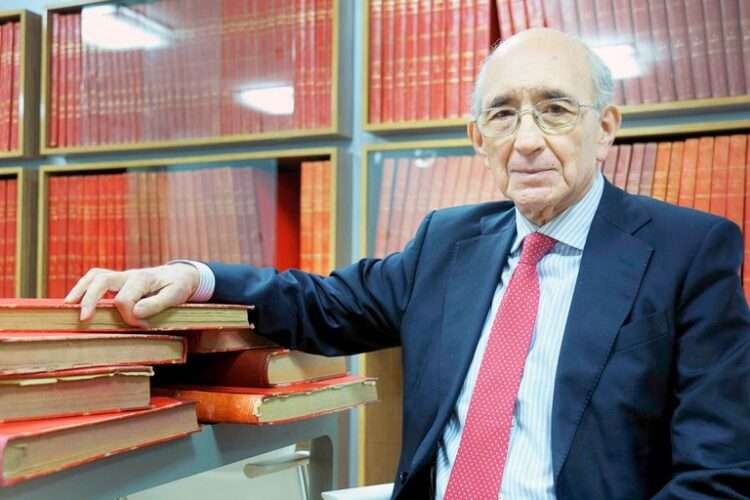
There are many recognitions that can be given to José María Ballester from different institutions: Fundación Botín, where he worked in recent years, or Hispania Nostra, as he was one of its founders. But we, from the Spanish Federation of Associations of Friends of the Camino de
Santiago, we want to recognize the support you always showed us. We still fondly remember his presence, together with Marcelino Oreja, at the closing of the XII International Congress of Jacobean Associations, held in Madrid in October 2021.
But his love and interest in the Camino de Santiago went back, in his own words, to his childhood. This is what he told us in a colloquium at the San Pablo CEU University in Madrid, in which he participated together with Marcelino Oreja, on the occasion of the 30th anniversary of the Declaration of the Camino de Santiago as First Europe Cultural Itineraryeither. He said that during the family summers in Sepúlveda he liked to look at the sky on clear nights, because it was already said that "Segovia was a land of few ears and many stars." He was fascinated to see a "long white spot of stars", which a certain local lady told him was the Milky Way that leads pilgrims to Santiago de Compostela. And he made, he said, a promise that when he grew up he would go to Santiago walking through the stars.
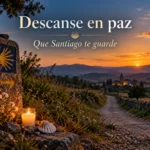
Today he has already undertaken that path, and his person, transformed into a star, is part of the Milky Way to be a guide in Heaven, as he was on Earth, for those who walk towards Compostela.