



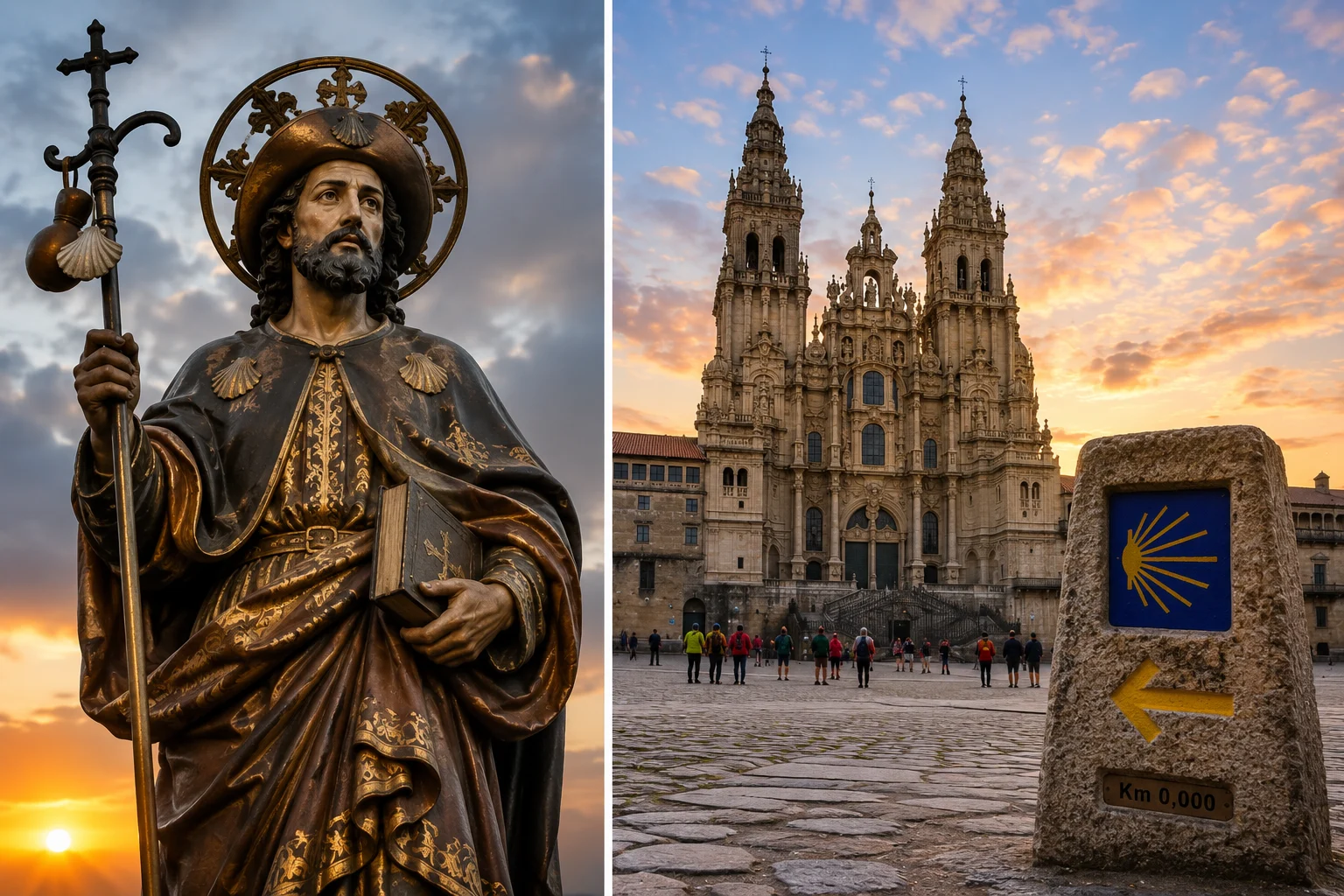
Every July 25, millions of people remember the figure of the patron saint of Spain, whose mark remains alive on the Camino de Santiago and in the faith of generations of pilgrims.
Every summer, thousands of pilgrims arrive excitedly at the Plaza del Obradoiro after traveling hundreds of kilometers along the different Jacobean routes. However, behind this ancient tradition is the figure of a man whose life forever marked the history of Spain: Santiago Apostle, one of the closest disciples of Jesus Christ and patron saint of Spain.
On the occasion of his festival, celebrated every July 25, the Cathedral of Santiago de Compostela once again becomes the epicenter of a religious, cultural and historical celebration that brings together believers, pilgrims and visitors from all over the world.
From a fisherman in Galilee to a disciple of Jesus
Santiago, known as James the Greater, was the son of Zebedee and brother of Saint John the Evangelist. They were both working as fishermen on the Sea of Galilee when Jesus called them to become “fishers of men.” Their passionate character made Christ nickname them "the children of thunder".
He was one of the three apostles who accompanied Jesus in some of the most important moments of his public life, such as the Transfiguration on Mount Tabor, the resurrection of Jairus' daughter or the prayer in the garden of Gethsemane.
Tradition places his preaching in Hispania
According to Christian tradition, Santiago undertook a journey to ancient Hispania to announce the Gospel. Although the historical sources about this trip are the subject of debate among specialists, this tradition gave rise to one of the most important devotions of Western Christianity and the birth of the Jacobean phenomenon.
One of the best-known episodes is the appearance of the Virgin Mary on a pillar in Zaragoza, an event that, according to tradition, strengthened the apostle in his evangelizing mission.
The first martyred apostle
After returning to Jerusalem, James was arrested during the persecution against the first Christians ordered by King Herod Agrippa I. He died beheaded with sword, becoming the first apostle to give his life for the Christian faith, around 44 AD
Tradition maintains that his disciples later transported his body by sea to the Galician coast, where centuries later his remains would be discovered.
The birth of Santiago de Compostela
In the 9th century, the discovery of a tomb attributed to the apostle in Galicia forever transformed the history of Europe. That discovery prompted the construction of the current Cathedral of Santiago de Compostela and gave rise to a network of paths that, over the centuries, would become one of the largest pilgrimage routes in the world.
Today, the Camino de Santiago Every year it receives hundreds of thousands of pilgrims from more than a hundred countries, attracted for religious, cultural, sporting or personal reasons.
A legacy that lives on
More than a thousand years after the discovery of his tomb, the figure of Santiago continues to be a symbol of hope, encounter and improvement. The yellow arrows, the scallop shells and the thousands of kilometers of trails that cross Europe are daily reminders of the influence of an apostle whose legacy continues to inspire millions of people.
Each pilgrim who reaches the Plaza del Obradoiro is part of a tradition that has survived wars, epidemics and social changes, turning the Camino de Santiago into a universal heritage and one of the greatest spiritual and cultural references in the world.

















