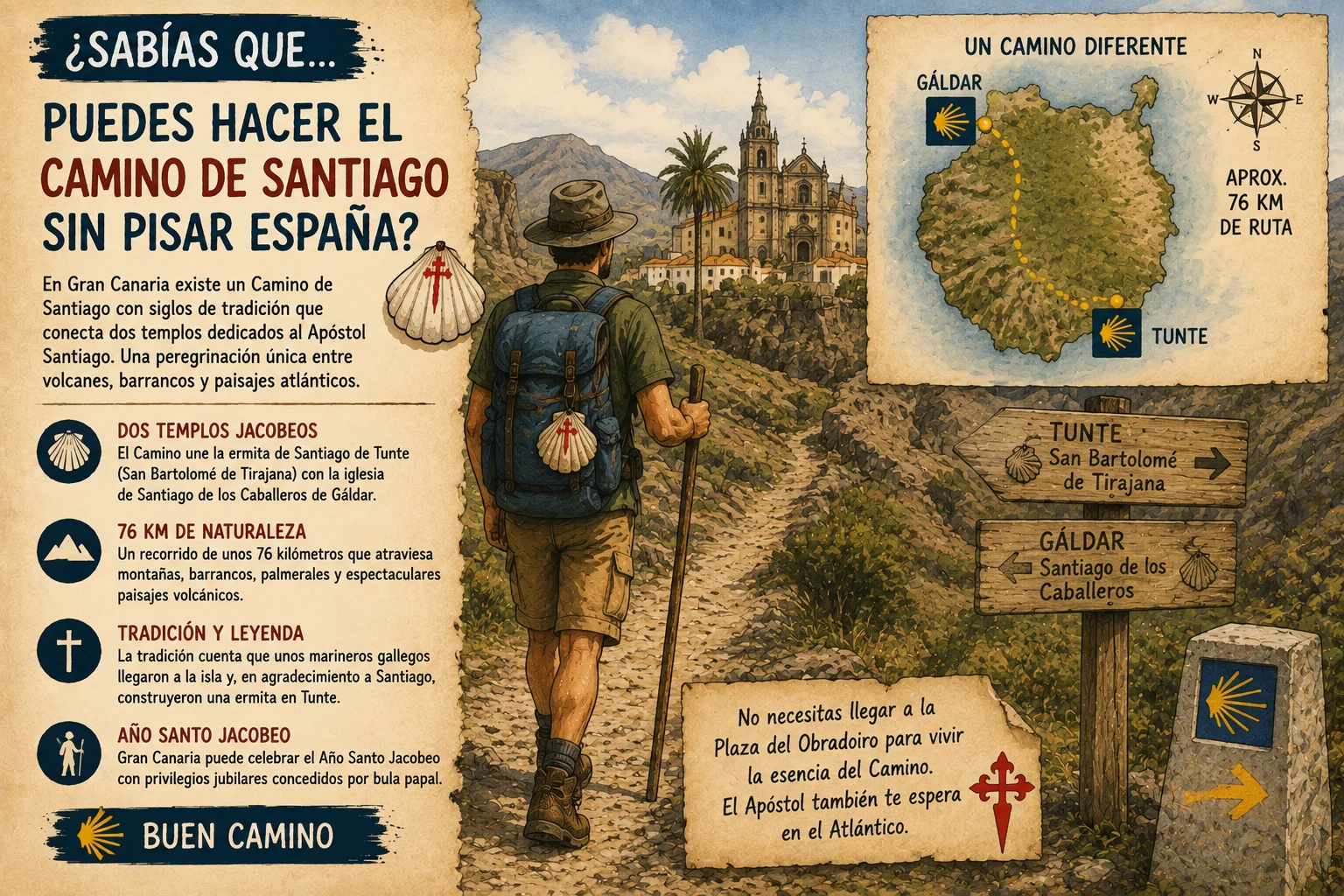
There is a Camino de Santiago between volcanoes, ravines and Atlantic landscapes that breaks with almost everything we imagine when we talk about the Jacobean route.
When someone says the words Camino de Santiago, almost all of us immediately think of Galicia, the Plaza del Obradoiro and the Cathedral of Santiago de Compostela.
But there is a Jacobean curiosity that still surprises many pilgrims: you can travel a complete Camino de Santiago without reaching Santiago de Compostela.
Of course, an important clarification must be made: saying that it can be done "without setting foot in Spain" would be incorrect, because the place we are talking about belongs to Spain. The really amazing thing is that you can do it without stepping on the Iberian Peninsula.
You have to travel to Gran Canaria.
Yes, you read that right.
In the middle of the Atlantic Ocean there is a Camino de Santiago de Gran Canaria, a pilgrimage with centuries of Jacobean tradition that crosses the island and connects two temples dedicated to the Apostle Santiago.
A path between volcanes
Forget for a moment about the Galician forests, the corredoiras and the rain.
Here the pilgrim finds ravines, mountains, palm groves, volcanic landscapes and some of the most spectacular natural settings in the Canary Islands.
The traditional route of Gran Canaria is linked to the Jacobean temples of Tunte, in San Bartolomé de Tirajana, and Santiago de los Caballeros de Gáldar.
The route crosses the mountainous interior of the island and allows you to discover an image of Gran Canaria completely different from that of its famous beaches. The Government of the Canary Islands has indicated a route of some 76 kilometers linked to this Path.
And behind this pilgrimage there is an extraordinary story.
It all started with some Galician sailors
One of the traditions associated with the origin of the Canarian Camino says that some Galician sailors They were surprised by a strong storm near Gran Canaria.
After surviving, they would have taken an image of Santiago to Tunte as a token of gratitude and a hermitage dedicated to the Apostle would have been built there.
The story partially moves between tradition and legend, but Jacobean devotion in Gran Canaria has been documented for centuries.
In 1481, Bishop Juan de Frías celebrated mass under the invocation of Santiago the Greater in Agáldar, and later the parish of Santiago Apóstol was founded there.
That is to say: while the Camino de Santiago was consolidated in Europe, devotion to the Apostle also took root more than a thousand kilometers from the Peninsula.
And here comes the truly surprising part.
Gran Canaria's relationship with Santiago is not simply touristic.
It also has a unique religious dimension.
In 1965, a papal bull granted Gran Canaria the possibility of celebrating the Jacobean Holy Year with jubilee privileges linked to its Jacobean temples. Later, since the Holy Year of 1993, that privilege was recognized in perpetuum, according to the Government of the Canary Islands.
This makes the Canarian Camino one of the great rarities of the Jacobean universe.
It is not simply a path that someone decided to name after Santiago.
Behind it there is its own historical and religious tradition.
A Path that does not end before the Compostela Cathedral
And here another of its peculiarities appears.
The pilgrim who makes this Camino does not end his journey in front of the Cathedral of Santiago de Compostela.
Its traditional destination is in Galdar, in the north of Gran Canaria.
Therefore, you can make a Jacobean pilgrimage between temples dedicated to Santiago, follow signs along the Camino, walk through several stages and live an experience linked to the tradition of the Apostle...
without ever reaching the Plaza del Obradoiro.
That breaks one of the most widespread ideas about the Camino.
From an island to an entire archipelago
The Canarian Jacobean initiative has even been expanded under the concept Camino de Santiago between Volcanoes.
The Government of the Canary Islands developed a network of tours around the eight islands and an application that allows you to follow the itineraries even without an internet connection. The system can digitally record the stages completed and specific badges linked to the island tours were created.
It is another completely different way of interpreting the Jacobean phenomenon.
Here the yellow arrows coexist with volcanoes.
The pilgrim can encounter arid landscapes, Canarian pine forests, mountains and enormous ravines.
And the ocean replaces a good part of the landscapes that we traditionally associate with the French Way.
The Camino is much bigger than Santiago
This story also serves to remember something that we sometimes forget.
He The Camino de Santiago does not begin in a specific place.
For centuries it has been formed from an enormous network of paths used by pilgrims from different parts of Europe.
France, Portugal and other European territories preserve Jacobean routes that historically led to Compostela.
They all converged, in one way or another, towards the tomb attributed to the Apostle.
Gran Canaria represents a fascinating exception within that enormous map.
So the next time someone tells you...
«To do the Camino de Santiago you have to go to the north of Spain».
You already know what to answer.
Not necessarily.
You can put on your backpack, follow Jacobean symbols, walk among mountains and volcanoes and end up in front of a temple dedicated to the Apostle Santiago...
without having set foot on a single kilometer of the Iberian Peninsula.
Because the Camino de Santiago has many routes.
But probably none will surprise as much as this one.