



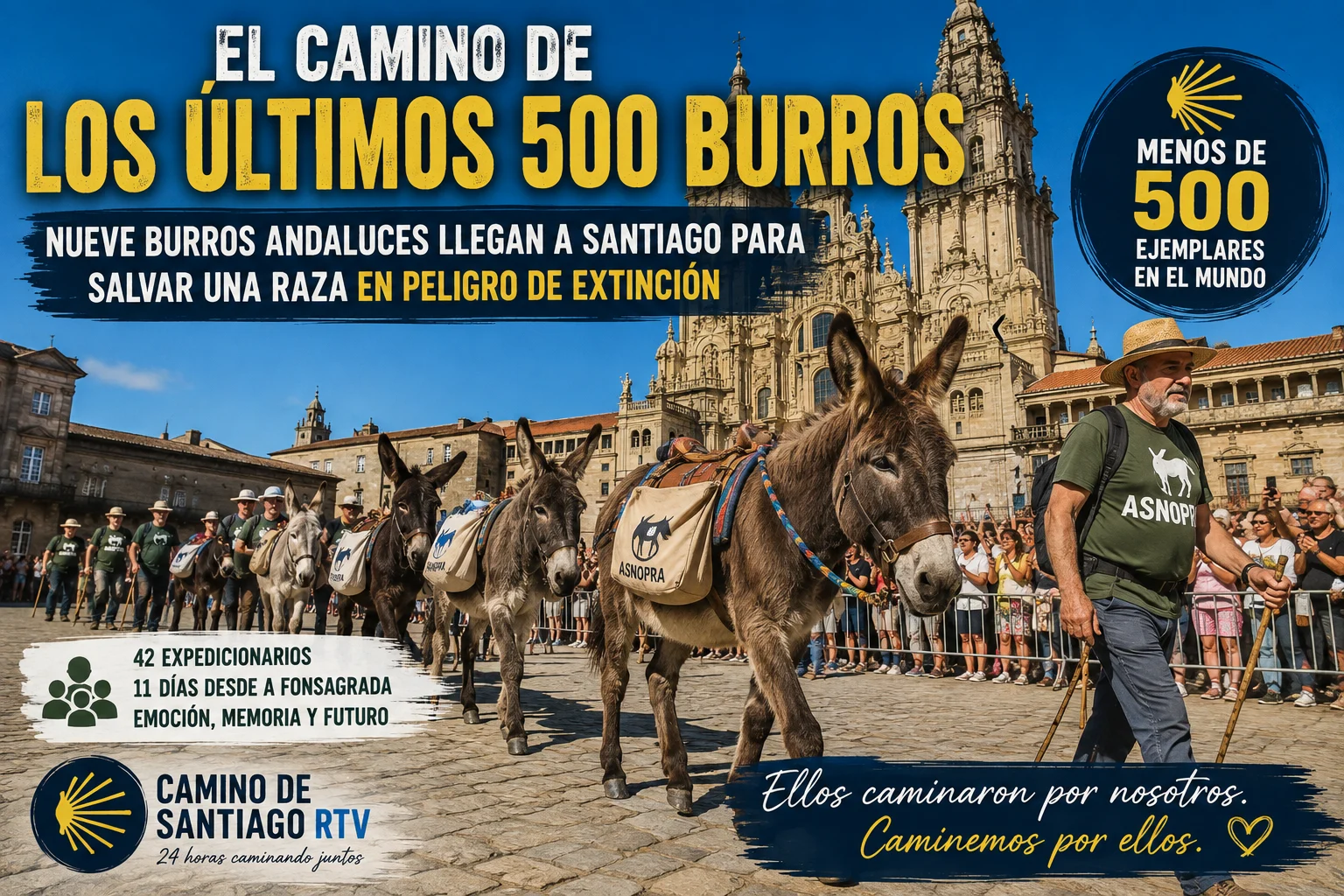
Nine Andalusian donkeys have arrived in Santiago after eleven days of the Camino. Behind one of the most endearing images of the summer hides a worrying reality: their breed is in danger of extinction.
SANTIAGO DE COMPOSTELA.— There was a time, not too long ago, when hearing the hooves of a donkey on the roads of Galicia was an everyday occurrence. They were part of the life of the towns, they helped in the fields, transported loads and accompanied men and women for hours on days that today seem to belong to another world.
This week, that sound returned.
And some couldn't hold back their tears.
Nine copies of Andalusian purebred donkey They have completed the Camino de Santiago accompanied by an expedition of 42 people. After eleven days walking from A Fonsagrada, arrived this Thursday at the Plaza del Obradoiro.
The photography is beautiful: pilgrims, children and donkeys in front of the Cathedral of Santiago.
But behind her there is a call for help.
There are less than 500 specimens of this native breed left.
And those who have walked the Camino with them want to prevent it from disappearing.
Nine donkeys walking towards Santiago
The initiative belongs to the Andalusian Purebred Donkey Association (Asnopra), which has once again chosen the Camino as a showcase to draw attention to the delicate situation of these animals.
It's not the first time.
The association already carried out a similar experience in 2022 and now, four years later, it has taken its donkeys to Santiago again.
On this occasion they have participated 42 expeditionaries, from children to retired people. Among them there was even a grandfather who did the experience accompanied by his grandson.
For eleven days people and animals have shared paths, breaks, meals and many hours together.
The stages were generally around 15 kilometers, although there were two considerably longer days, 22 and 27 kilometers. According to those responsible for the expedition, the animals completed the route in very good physical condition.
The adults waited hours to see them pass
But perhaps the most beautiful story of this Camino did not occur in Santiago.
It happened before.
In small Galician towns.
Álvaro Jiménez, president of Asnopra, said that during the tour they met older people who came to stay three or four hours waiting in front of their houses simply to contemplate the passing of the donkeys.
And when they finally appeared, some were excited.
Those animals took them back to their childhood for a few minutes.
To his parents.
To his grandparents.
To a rural Galicia in which the donkey was an inseparable companion of daily work.
As Jiménez explained, many of these people remembered how they lived with these animals in the past, how they fed them and how they were part of the economy and family life.
El Camino thus became, unexpectedly, a time machine.
The pilgrims advanced towards Santiago.
The elders returned for a few minutes to their youth.
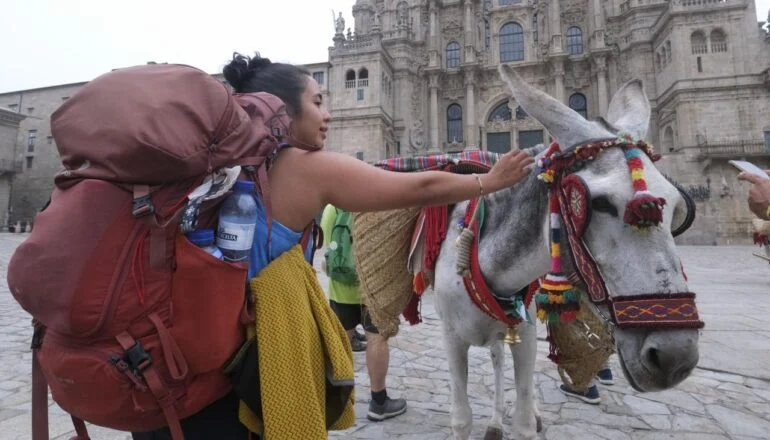
A coexistence that remembers the ancient muleteers
Walking with an animal for eleven days also changes your relationship with it.
The participants have spent days of almost eight hours working and living with the donkeys, recovering in some way that daily relationship that the ancient muleteers had for generations.
They were not simply animals that accompanied the expedition.
You had to take care of them, know them, walk with them and adapt to their needs.
The president of Asnopra himself remembers how in the past it was said that the donkeys that lived permanently with people seemed to understand practically everything.
And that nobility is precisely one of the characteristics that the association wants to claim.
Less than 500: a critical situation
The most worrying part comes when the Obradoiro celebration ends.
He Andalusian purebred donkey is in a critical situation.
Asnopra speaks of less than half a thousand censused specimens.
Added to this are problems such as the geographical dispersion of the animals, inbreeding and a particularly slow reproductive cycle: the gestation of a donkey lasts approximately twelve months.
Every copy matters.
Every birth matters.
And getting new generations to know these animals also matters.
Precisely there appears a little hope.
The association ensures that among its ranchers there is generational change and people of different ages involved in the conservation of the breed.
The children were the ones who enjoyed the most
And perhaps there is another sign of hope.
Five children participated in this adventure.
According to those responsible for the expedition, they were probably the ones who enjoyed the entire tour the most.
It may seem like a minor detail, but it is not.
The survival of many native breeds does not depend solely on conservation programs. It also depends on getting new generations to look at them again with interest and understand the role they played for centuries.
The Camino has allowed precisely that.
That the elders would remember.
And that the little ones would discover.
A different path
We are used to seeing pilgrims arriving at the Obradoiro on foot, by bicycle or, occasionally, on horseback.
The arrival of nine donkeys completely breaks that everyday image.
But perhaps it is not as strange as it seems.
Long before ultralight backpacks, GPS watches and mobile apps, European roads were full of animals.
They transported goods.
They worked in the fields.
They accompanied travelers.
And they were also part of the landscape that the pilgrims found.
That is why this small caravan arrived from A Fonsagrada has something deeply ancient.
Walk so as not to disappear
The nine donkeys have already arrived in Santiago.
They have crossed towns, caused smiles, awakened memories and managed to make people talk again for a few days about a race that is fighting to survive.
Asnopra hopes to repeat the experience within four years.
I hope they can do it.
Because behind this endearing image of the Camino there is a much more serious issue.
If a breed falls below 500 individuals, every effort to preserve it counts.
This time they did not arrive in Santiago looking for a Compostela.
Not even breaking a record.
Not even trying to do the Camino faster than anyone else.
They walked so that their race would not disappear.
And perhaps there are few more beautiful reasons to set out on the Camino.

















