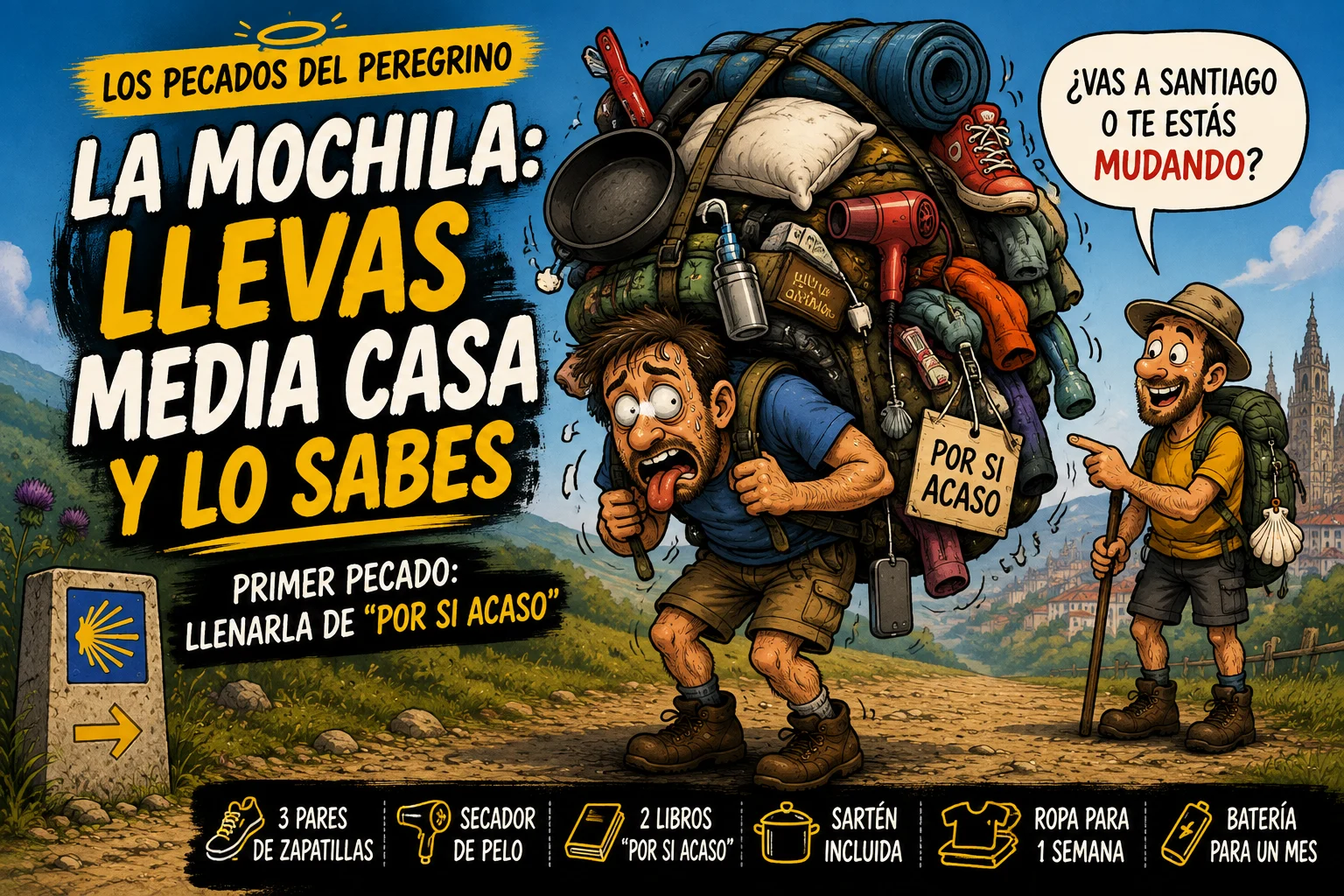
First sin of the pilgrim: filling the backpack with “just in case”. The Camino has a curious ability to show you, kilometer by kilometer, that you needed much less than you thought.
There is a wonderful moment before doing the Camino de Santiago for the first time. You extend the backpack On top of the bed, you place everything around it and begin to carefully prepare what you consider essential.
Two pants.
Three t-shirts.
A fleece.
Another thinner one, just in case.
Raincoat.
Walking shoes.
Footwear to rest.
Flip flops.
A sweatshirt.
A book, because you will surely have a lot of time to read.
An external battery capable of starting a tractor.
First aid kit to survive three months isolated in the Himalayas.
And then the most dangerous expression in the history of the pilgrim appears:
"This too, just in case."
When you finish, you proudly contemplate your work.
The backpack weighs twelve kilos.
You weigh seventy.
But nothing happens.
You have read on the internet that the Camino transforms people.
What you still don't know is that The first transformation will probably involve turning you into a pack mule.
Day 1: "It doesn't weigh that much"
You leave in the morning full of enthusiasm.
Perfectly fitted backpack. Impeccable boots. Prepared credential. Photography for Instagram.
The first three kilometers are wonderful.
At eight you start to notice your shoulders slightly.
At twelve you discover that that second pair of pants may not have been strictly necessary.
At seventeen you begin to mentally negotiate with your belongings.
And when you arrive at the hostel something extraordinary happens.
You open the backpack and look at objects that just a few hours before you considered essential as if they were your worst enemies.
What the hell did I bring this for?
Welcome to the Camino.
The great enemy: "just in case"
A heavy backpack is rarely filled with just one absurd thing.
The problem is small decisions.
One more t-shirt.
300 grams.
Another pants.
400 grams.
A huge toiletry bag.
500 grams.
A second shoe that is too heavy.
700 grams.
A gigantic bottle.
An additional charger.
A book.
Too big a towel.
A sweatshirt that you probably won't use.
One by one they seem innocent.
Together they can add several kilos.
And there is a wonderful feature of the weight: What seems bearable in the morning can become a condemnation after twenty kilometers.
"But it's only half a kilo"
This is another of the classic phrases.
Clear.
Half a kilo doesn't seem like anything.
Grab a half-liter bottle of water and hold it for thirty seconds.
Absolutely nothing happens.
Now imagine transporting it for five, six or seven hours, up and down roads, for several consecutive days.
The conversation changes.
That's why preparing a backpack doesn't just consist of asking yourself:
“Can I wear this?”
The correct question is:
“Do I really need to carry this around every day?”
How much should a backpack weigh?
Here it is advisable to abandon the jokes for a moment.
There is no magic weight valid for absolutely everyone. It depends on the physical constitution, time of year, duration, route, accommodation, personal needs and material needed by each pilgrim.
As a common guideline, many hiking recommendations place the load around the 10% of body weight when we talk about a relatively light backpack for a multi-day route.
But it shouldn't become a mathematical obsession.
An 80-kilogram person has no obligation to fill his backpack to eight simply because he “can.”
The less unnecessary weight we carry, the better.
A backpack for sleeping in shelters during the summer can be very different from the one needed for hiking in winter.
Common sense should outweigh any percentage.
The parade of objects that return intact
Ask pilgrims who have completed a Camino what they took and never used.
The answers can be magnificent.
Extra clothes.
Huge hygiene products.
Multipurpose knives prepared to build a cabin.
Medications for diseases that probably only exist in documentaries.
Three chargers.
A speaker.
Books.
Jeans.
Cosmetics.
And a surprising number of objects whose justification always starts the same:
"I thought maybe..."
El Camino has shops.
It has pharmacies.
It has supermarkets.
It has towns.
And, except for some specific routes and stages where we do need to correctly provide water and food, We are not passing through completely uninhabited territory..
The dryer deserves its own chapter
Yeah.
There are pilgrims who carry a hairdryer.
And we deeply respect all vital decisions.
But when you're climbing an endless hill in the sun and you've been walking for six hours, you'll probably find that the volume of your hair is no longer one of the first places among your concerns.
That is another teaching of the Way.
Simplify priorities.
A lot.
The box of truth
Anyone who has frequented shelters will have seen some variant of this phenomenon.
Objects abandoned or voluntarily left for another pilgrim to use.
Because?
Because there comes a time when the body begins to make decisions that the brain refused to make at home.
That essential t-shirt is no longer essential.
The huge pot stays.
The book stays.
The additional pants are starting to get a lot of attention.
Each abandoned object tells a small story of regret.
True luxury is carrying less
There is a kind of silent competition between some veteran pilgrims.
—How much does yours weigh?
—Six kilos.
—Mine five and a half.
Then someone with four kilos appears and everyone looks at him as if he had discovered nuclear fusion.
There is no need to go to extremes either.
The goal is not to win an ultralight world championship.
The goal is to find a balance between comfort, safety and weight.
You need appropriate clothing.
Protection against rain and cold when appropriate.
Water.
Documentation.
Basic hygiene material.
Personal medication.
Appropriate footwear.
And what you really need according to your Path.
But you probably don't need to move your entire bedroom to Santiago.
The Camino teaches you to let go
Here the joke begins to have some truth.
During our lives we accumulate things.
Also worries, obligations and routines.
And when you start walking you discover that for a few days you can live with everything you need in a backpack.
You get up.
You walk.
You eat.
Speak.
You rest.
You sleep.
And you start again.
Suddenly, having less doesn't seem like a lack.
It can become a freedom.
Perhaps that is why many pilgrims return home surprised by the amount of things they have.
The RTV “just in case” rule
From Camino de Santiago RTV We propose an absolutely scientific method - or almost - to prepare the backpack.
Every time you enter something saying:
"I carry it just in case..."
Take it out again.
Leave it on the bed.
Wait ten minutes.
And ask yourself:
"If I don't wear this, what real problem would I have?"
If the answer is serious, put it back in.
If the answer is:
"Well... maybe one night I want to dress up for dinner", you probably just saved a few grams.
Do it twenty times.
Your shoulders will thank you.
Pilgrim's first sin
We thus inaugurate our Sins of the Pilgrim.
And the first had to be this:
SIN Nº1: CARRYING HALF THE HOUSE IN YOUR BACKPACK
Because practically all of us have committed some version of it.
The Camino will end up teaching you many things.
But one of the first arrives quite quickly:
You don't need as many things as you thought.
And if you still hesitate while packing your backpack, ask yourself one last question:
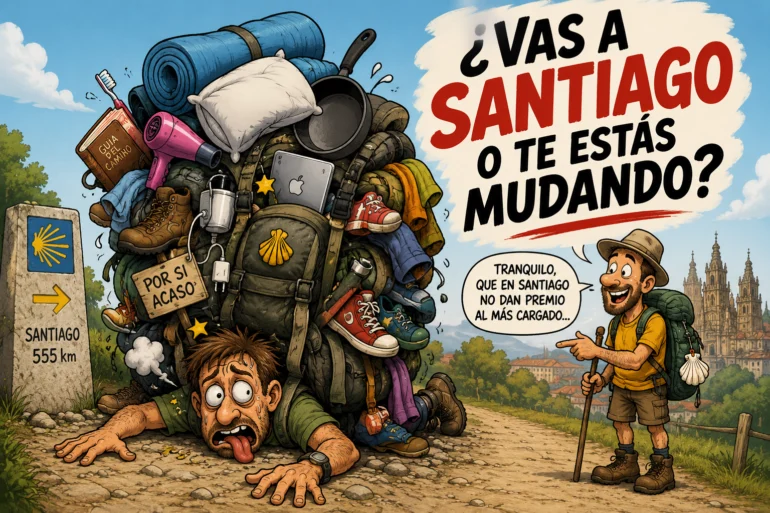
Are you going to Santiago... or are you moving?