



He had traveled practically the entire Camino. Santiago was already just one day away. But William Watt never got to embrace the Apostle. He died on August 25, 1993, in the middle of the Holy Year, while walking through Salceda, in the municipality of A Coruña. O Pine. More than three decades later, thousands of pilgrims continue to pass by the small memorial that keeps their history alive.
There are places on the Camino de Santiago that do not appear among the great monuments in the guides and that, however, manage to stop the pilgrim. One of them is located in Salceda, in the final stretch of the French Way, when the proximity of Santiago begins to be felt in a special way.
There, next to the Camino, bronze boots and an inscription commemorate a man whose journey ended when the goal seemed to be within reach.
His name was William Watt.
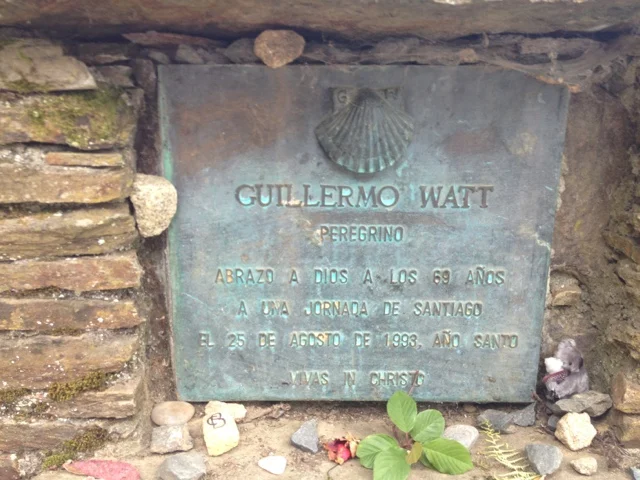
One day from Santiago
It was him August 25, 1993. Spain was experiencing a Compostela Holy Year and Guillermo Watt was walking the Camino de Santiago.
He had reached Salceda, in O Pino. From there it was approximately one day to reach Santiago de Compostela.
He couldn't continue.
The historical documentation of the Spanish Federation of Associations of Friends of the Camino de Santiago records his death that day and identifies him as engineer from Madrid. The magazine Pilgrim, in an issue published in 1994, also reproduced the inscription that still remembers the walker: Guillermo Watt died at 69 years, "one day from Santiago."
The detail is especially moving for anyone who has walked the French Way.
In those last kilometers, Santiago has stopped being a distant idea. The pilgrims begin to talk about the arrival, the entry into the city, the Obradoiro, the Cathedral and what they will do when they finally leave their backpack on the ground.
Guillermo was practically there.
But his Camino ended before.
Boots that force you to stop
A memorial was left in the place that has become, over the years, one of those small symbols that are part of the sentimental memory of the Camino.
The Federation itself reported shortly after his death that in the monument there were placed bronze boots inspired by those worn by the pilgrim, while his family left a phrase that probably explains better than any other what happened next with his memory:
"He was our father but now he is your pilgrim."
And, in a way, that's what happened.
Generations of walkers have passed through Salceda since then. Some continue on; others slow down when discovering the monument. There are those who leave a stone, some flowers or a small improvised cross.
The Ministry of Culture expressly includes the memorial of Guillermo Watt in the description of this stage of the Camino and remembers that it is located practically on the route itself.
The Camino also preserves the memory of those who did not arrive
Guillermo Watt's story recalls a reality of the Camino de Santiago that is normally overshadowed by the happy photographs of the Obradoiro.
Not all pilgrims reached Santiago.
This occurred for centuries and continues to be part of the history of pilgrimages.
In the Middle Ages, undertaking the Camino meant facing illnesses, accidents, hunger, cold and journeys that could last for months. Many pilgrims died during the journey and were buried far from their places of origin.
Today the conditions are radically different, but the Jacobean routes still preserve small memorials dedicated to deceased walkers.
The historian and specialist on the Camino Anton Pombo has written precisely about these memories scattered along the Jacobean routes, small testimonies that turn certain points along the Camino into places of memory for those who died before completing their journey. Among them he expressly mentions the sandals dedicated to Guillermo Watt in Salceda.
Thousands of pilgrims pass by today
It's been almost 33 years since August 25, 1993.
El Camino has changed enormously since then. There are more pilgrims, more hostels, mobile phones, applications, backpack transport and services that Guillermo could hardly have imagined while walking towards Compostela.
But the place remains.
Salceda continues to be part of the final section of the French Way between Arzúa and O Pedrouzo. Current guides continue to point out the monument to Guillermo Watt as one of the unique points of this part of the route.
And every year new pilgrims discover his name for the first time.
Many probably don't know who he was before they got there. They do not know his profession, his previous life or the reasons that led him to start walking towards Santiago.
They only know the essentials:
He was a pilgrim, like them.
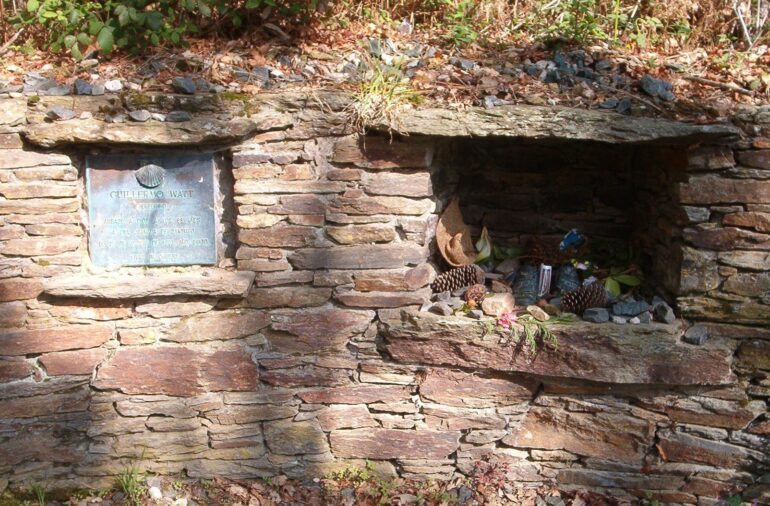
Guillermo Watt does remain on the Camino
Perhaps that is why his story continues to excite more than three decades later.
The Camino de Santiago is built around a goal. For hundreds of kilometers everything seems to lead to the same place: the towers of the Cathedral, the Plaza del Obradoiro and the end of the pilgrimage.
But stories like that of Guillermo Watt remind us that the Camino cannot always be measured by having arrived.
His name never appeared among the pilgrims who celebrated their entry into Santiago that day.
He could not complete that last day.
However, since 1993, Millions of steps have continued passing by the place where yours ended.
And as long as the pilgrims continue stopping for a few seconds before those bronze boots in Salceda, Guillermo Watt will continue, in some way, to be part of the Camino de Santiago.

















