



Jacobean sacrilege! The Garbage Invasion of False Traditions that Desecrate Santo André de Teixido
Dirty handkerchiefs, socks and mountains of stones: the 'Path' of tourist ignorance buries authentic devotion in Cedeira, turning an ancient sanctuary into a dumping ground for "selfies" and cheap superstitions. Enough of desecrating Galicia!
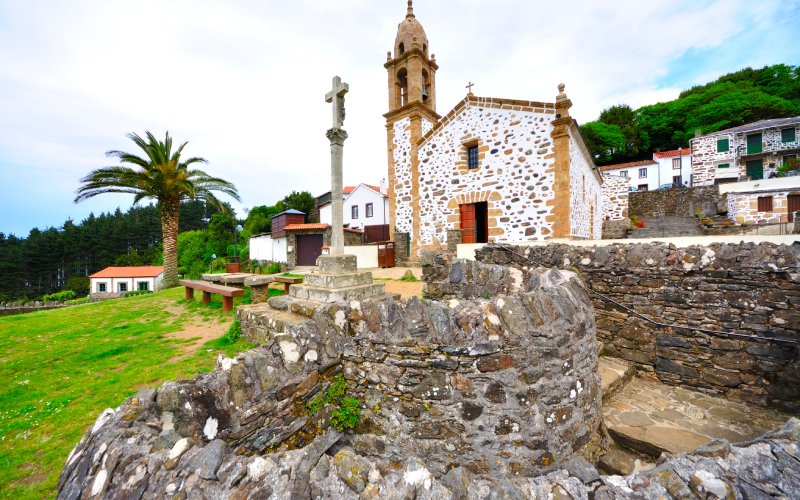
Santo André de Teixido, Galicia – It is an image that should stir consciences, but that, unfortunately, is becoming the norm: wires full of papers, used masks, handkerchiefs, and even underwear! This is not a makeshift clothesline or a modern art installation; It is the unfortunate scenario that the "tourists" (if you can call them that) and pilgrims are leaving in their wake through the idyllic village of Saint André of Teixido, in Cedeira. The neighbors are rightly fed up, and the natural beauty of the surroundings is drowning under an avalanche of false piety and rubbish.
The height of barbarism is the erection of a grotesque "milladoiro" or cairn in front of the sanctuary. A cluster of stones that, one by one, are crowded together by the absurd individual need to leave a record of "I was here." A hoax that, when multiplied, becomes a collective problem of scandalous dimensions. Both the "flaps" and the piles of stones are, quite simply, false invented customs that have nothing to do with the millennial Camino de Santiago nor with Galician traditions. The Association for the Defense of Galician Heritage has raised the alarm, demanding their eradication.
The Plague of “I Was Here”: From Paris to Teixido, the Same Stupidity
Like the padlocks that disfigured the bridges of Paris or Venice, mass and misinformed tourism always finds a way to leave its destructive mark. Who started this ridiculous trend in Teixido? Nobody knows, but imitation is a virus. "In the end you see that there are handkerchiefs hanging and say 'well, I'm going to hang them too, it will be tradition,'" confesses an unsuspecting visitor. Nothing could be further from the truth. It is a practice generated by modern pilgrims themselves, a unhealthy and rootless neotradition which the villagers themselves vehemently reject.
Antonio Rúa Saavedra, the priest of the sanctuary, laments what he finds: "handkerchiefs, diapers, women's panties and even underwear." "Of everything there has been and to be" is hung on the fences and wires of the town's meadows. The local indignation is palpable: "The paper tears and gets wet, in the end it is filthy," points out a neighbor, while another says: "it is not a tradition of the ancestors, it is something that is not hygienic."
The Outraged Sanctuary: Respect Lost, Sacredness Diluted
While the authentic traditions of the sanctuary, such as "making a wish and drinking from the three spouts" of the fountain, are ignored or distorted, tourists choose to pile stones on the entrance walls to the church. A practice already annoying on beaches throughout Galicia, which now contaminates a sacred space.
Sergio Muíño, founder of the 'Eu fun de vivo' project, which organizes guided tours, makes it clear: "Of course we are not going to question the faith, the belief or the motive, but it is true that they can have an impact on the sanctuary and on the heritage, because in the end they pile up on the doors, on the architecture." The problem is not one stone, but a thousand stones. "After you there will be a thousand more stones," he warns.
The priest Saavedra is forced to remove these "memories", not because of work, but because of the pain of seeing how the intention is distorted. But he knows he must do it. This beautiful and sacred place does not ask for photos for social networks or leaving personal trash. Just demand I respect, a quality that, unfortunately, seems increasingly absent in certain visitors. Faith without civic education is not faith, it is vandalism.

















