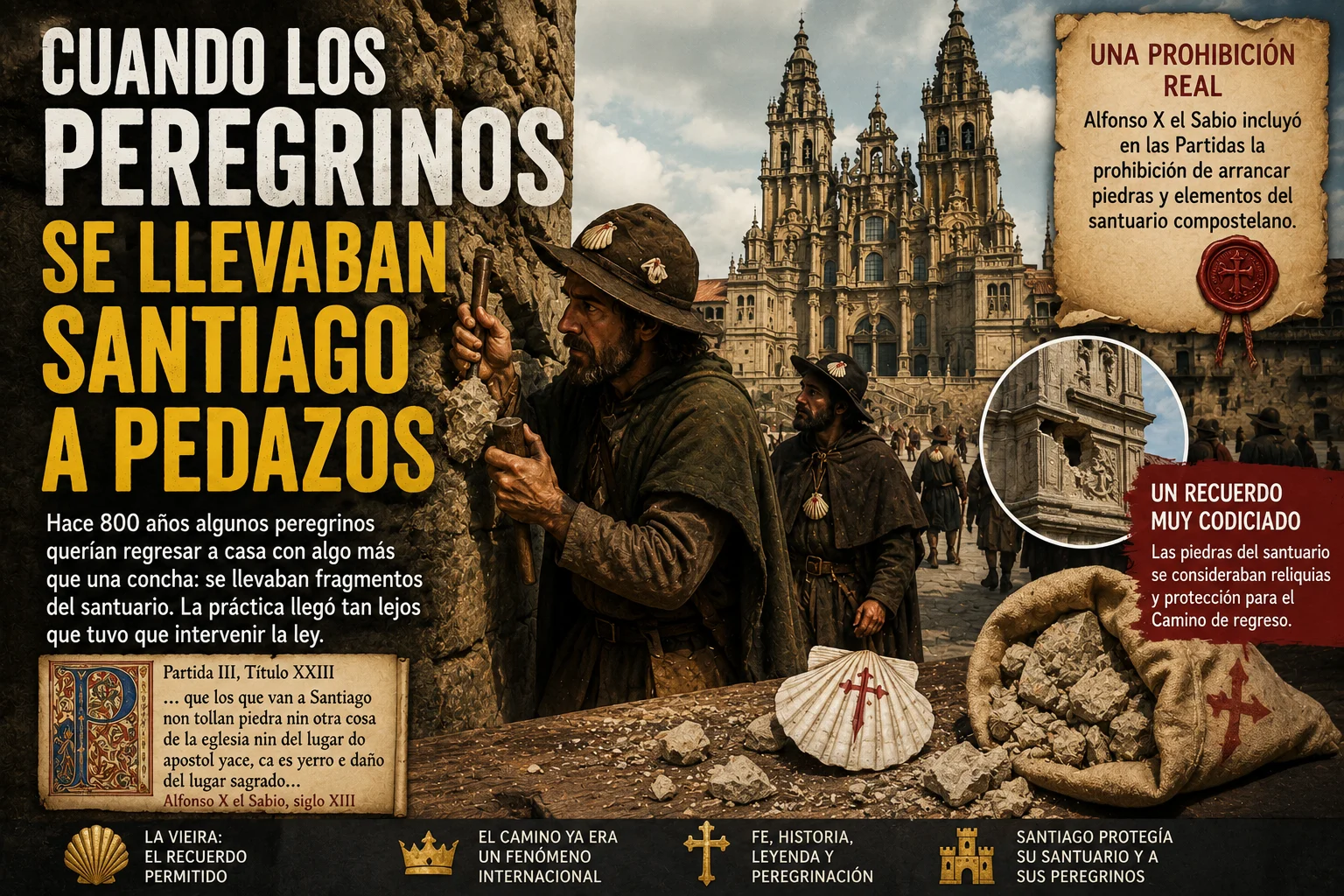
The most unusual memory of the medieval Camino: for centuries, some pilgrims tore off fragments of the temple itself to take them home
Today a pilgrim arrives at Santiago de Compostela, photograph the Cathedral, buy a shell, keep your credentials and perhaps take a souvenir with you.
Centuries ago, some had a much more radical idea.
Take a piece of the Cathedral.
It may seem like a legend invented for tourists, but behind this surprising story there is medieval documentation. The practice became a serious enough problem that the authorities had to intervene.
And one of the most extraordinary testimonies appears in the Games of Alfonso X the Wise, in the 13th century.
Pilgrims who wanted to return home with a stone
To understand it you have to mentally travel back to the Middle Ages.
Getting to Santiago was not an excursion.
A pilgrim could spend weeks or months walking along dangerous paths, crossing mountains, forests, rivers and unknown territories.
There were no telephones.
There was no GPS.
There was no train to return home if something went wrong.
Reaching the tomb of the Apostle could become the most important event of a lifetime.
And after such a trip, many pilgrims wanted to return to their places of origin taking with them something that would prove that they had really been there.
The scallop shells would end up becoming the great symbol of that pilgrimage.
But some were looking for something even more special.
A stone.
A small fragment of the sacred place.
The problem went too far
The custom of carrying religious souvenirs was not exclusive to Santiago.
During the Middle Ages there was an enormous fascination with relics and objects that had been in contact with places considered holy.
A fragment from a shrine could become an extraordinarily valuable object for someone who returned to their village.
But imagine thousands and thousands of pilgrims doing the same.
A stone today.
Another morning.
Another the following week.
For years.
That could end up damaging buildings and sacred spaces.
And precisely for this reason we find an extraordinary reference in medieval Castilian legislation.
Alfonso X had to say: the stones stay in Santiago
The Seven Games, a great legal work promoted during the reign of Alfonso X the Wise In the 13th century, they talk about pilgrims and the protection they should receive.
But they also have limitations.
Among them is the prohibition against those visiting Santiago tearing down certain items to take with them as souvenirs.
The legislation specifically mentions the custom of taking things from the Apostle's place.
It is a small window to a scene that is incredible today:
Medieval pilgrims trying to return home with physical memories of the Compostela sanctuary.
The medieval souvenir
We currently buy magnets.
In the 13th century they were looking for objects loaded with religious meaning.
The difference seems huge, but the human need behind it is probably the same.
We want to preserve something of the places that have changed us.
A modern pilgrim keeps photographs on his phone.
Another keeps his Compostela.
Another places a shell on a shelf.
And some even get a yellow arrow tattooed after finishing the Camino.
The medieval pilgrim also needed to demonstrate—to others and to himself—that he had arrived.
The scallop solved part of the problem
Precisely the scallop shell It ended up becoming the great memory of Santiago.
For centuries it was closely linked to the arrival in Compostela.
He Codex Calixtinus, from the 12th century, already talks about the shells associated with the Jacobean pilgrimage.
Pilgrims could purchase them in Santiago and place them in their hat, cape or bag.
It was visible.
It was recognizable.
And, above all, it was not necessary to dismantle any building to obtain it.
Over time, the scallop became one of Europe's most recognizable traveling symbols.
But Santiago had another problem: the false pilgrims
The popularity of the Camino also generated a curious phenomenon.
Not everyone who dressed as a pilgrim had necessarily performed the pilgrimage.
The status of pilgrim could provide protection, hospitality and help during the journey.
That opened the door to abuse.
People who disguised themselves as pilgrims could try to take advantage of the charity intended for real walkers.
The Middle Ages also had their "fake pilgrims."
That is why documents, symbols and systems emerged aimed at identifying and protecting the authentic pilgrim.
The Camino was already an international phenomenon
All this demonstrates something even more important.
Does 800 years, Santiago de Compostela already had to face some of the problems typical of a great international destination.
Crowds.
Accommodation.
Security.
Trade.
Memories.
Picaresque.
Control of pilgrims.
Protection of heritage.
Even inappropriate behavior of certain visitors.
Does it look familiar to you?
Almost a thousand years later, Santiago continues to debate many of those same issues.
A story that changes our image of the medieval Camino
Sometimes we imagine the medieval pilgrim walking solemnly, praying throughout the journey and arriving in silence at the tomb of the Apostle.
The reality was much more human.
There was faith.
But also commerce.
Parties.
Thefts.
Taverns.
Wiles.
Hospitality.
Diseases.
Friendships.
Fights.
And pilgrims who wanted to take souvenirs home.
Exactly like now, although without Instagram.
The next time you enter the Cathedral…
Look at their stones.
For centuries they have watched the arrival of kings, peasants, soldiers, religious people, adventurers and millions of anonymous pilgrims.
Some came from places thousands of kilometers away.
Others never made it home.
And there were those who, after overcoming one of the most difficult trips of their lives, thought that an imaginary photograph was not enough.
They wanted to take Santiago with them.
Literally.
Until they had to be reminded of something quite simple:
Buen Camino… but the stones of Santiago stay in Santiago.