



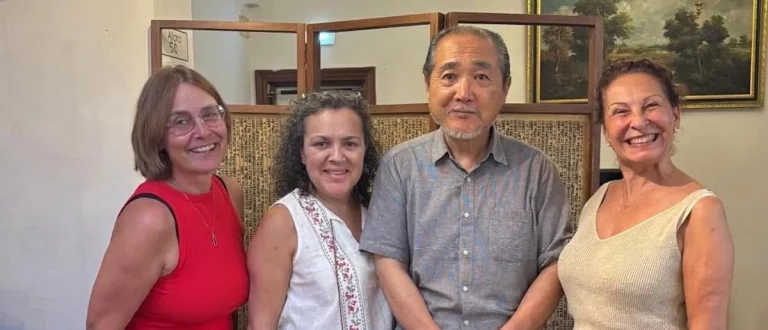
Pedro Incheol Lee is 65 years old, was born in South Korea and has lived in Argentina, the Canary Islands and Madrid. After years of work, economic difficulties and a life that ended up leading him to exhaustion, he found a place to start again on the Camino de Santiago. Today he lives in Hornillos del Camino, a small town in Burgos with less than 50 inhabitants, and cooks for the pilgrims who pass by his door every day.
There are pilgrims who finish the Camino in Santiago and return home.
And there are others who, after walking it, discover that their house was precisely there, at some point along the route.
Something similar happened to Pedro Incheol Lee, a man born in South Korea who, after traveling half the world, has ended up finding his place in Hornillos del Camino, a small town in Burgos located on the Camino Francés.
Pedro defines himself with a phrase that summarizes his story quite well: “I am a Korean Catholic pilgrim”.
But behind those few words is a lifetime of travel, work, difficulties and changes.
From Korea to Argentina and then to Spain
Pedro left South Korea in 1977, when his father decided to move to Argentina. He remained there for twelve years before beginning a new stage in Spain.
He first arrived in Las Palmas de Gran Canaria, where he lived for approximately a decade, and later settled on the Peninsula.
His professional life was always closely linked to two worlds that would end up meeting years later on the Camino de Santiago: tourism and gastronomy.
He worked as a guide, coordinated trips and also dedicated himself to teaching Japanese, Korean and Spanish cuisine.
Over time he also began to know the Camino de Santiago better and better, especially the section between Burgos and León.
A small town that remained in his memory
During his journeys along the French Way he passed through several times Hornillos del Camino.
The town is one of those places that many pilgrims pass through after leaving Burgos, surrounded by wide fields of Castile and that horizon that seems to never end.
One day, while passing by, Pedro saw a house for sale.
The price caught his attention and he decided to buy it, initially thinking of using it as a vacation spot and, perhaps one day, as a retirement residence.
Then he still couldn't imagine to what extent that decision would end up changing his life.
The pandemic changed everything
The pandemic hit his professional activity hard.
Tourism, one of the sectors to which Pedro had dedicated a good part of his life, practically stopped.
He then tried to continue working in Madrid and started a restaurant, but what was supposed to provide him with a way of life ended up becoming too heavy a burden.
Expenses, schedules, travel and daily effort began to accumulate.
He even slept some weekends in the establishment itself to avoid wasting time traveling.
For approximately a year and a half he maintained that rhythm until his body finally said enough.
Pedro became ill and understood that he had to change.
Return to the Camino to start again
When he decided to leave that Madrid project behind, he thought about Hornillos del Camino again.
In that small town in Burgos I had precisely what I missed more and more.
Space.
Silence.
Field.
A quieter life.
And pilgrims.
Pedro then decided to move there and begin a new stage.
I wouldn't leave the kitchen.
Neither does tourism.
I would simply live them differently.
Nanumi, Korean cuisine on the French Way
This is how it was born Nanumi, his new restaurant in Hornillos del Camino.
The establishment occupies a building that for years had had different uses and that had originally been the old town school.
Today, where the children of Hornillos used to go, pilgrims from numerous countries sit.
The proposal combines Korean cuisine with Spanish influences and products, offering dishes different from what a pilgrim normally finds during the Castilian stages of the French Way.
Bibimbap, noodles, soups and different Asian preparations now appear unexpectedly in the middle of the Burgos landscape.
And perhaps that is precisely where part of the magic lies.
A pilgrim can spend hours walking through wheat fields and, upon reaching a small Castilian town, find a Korean cooking for him.
Few images better represent the international character that the Camino de Santiago has acquired.
Cooking can also be hospitality
But Pedro's story is not simply that of an exotic restaurant located in a small town.
There is something else.
He himself was a pilgrim.
Know tiredness.
You know those afternoons when you arrive after many kilometers simply looking for a place to sit, drink something and regain your strength.
Now it's on the other side.
It is no longer just who walks.
He is the one who receives the walkers.
And cooking has become their particular form of hospitality.
Preparing a hot meal for a person who has been walking for hours may seem simple, but on the Camino these small gestures take on a different meaning.
A town of less than 50 inhabitants open to the world
Hornillos del Camino only has a few dozen residents, but every season thousands of people cross its streets.
Koreans.
Americans.
Germans.
Italians.
French.
Spanish.
People from practically any corner of the world.
For a few months a year, a small town in Castilla becomes one of the most international places imaginable.
Pedro fits perfectly into that reality.
He was born in Korea, lived in Argentina, came to Spain and ended up settling in a tiny town thanks to a medieval pilgrimage route.
His own life seems almost another Camino.
When arriving means staying
We normally talk about the Camino de Santiago as a journey to Compostela.
But stories like Pedro's show another dimension.
The Camino also transforms the places it passes through.
You can maintain small businesses.
Give life to rural towns.
Create relationships between completely different cultures.
And even convince a person arriving from the other side of the world that they have found the place where they want to stay.
Pedro assures that he is happy now.
He likes the open field.
He likes the tranquility.
And he continues doing what was always part of his life: cooking and interacting with travelers.
The difference is that now you don't need to search for them.
Pilgrims pass by its door every day.
From the pilgrim to the hospitable cook
Pedro arrived at the Camino walking like so many others.
Today he lives it from a different position.
Every day you see backpacks, walking sticks and tired people passing by as they continue towards Santiago.
Some enter Nanumi.
They sit down.
They eat.
They talk.
They rest.
And then they put the backpack back on.
Perhaps Pedro no longer needs to walk hundreds of kilometers to feel like a pilgrim.
Because the Camino now passes through his house.
And while others advance towards Santiago, he has found something there that many pilgrims have been searching for for weeks:
a place where you feel at peace.

















