



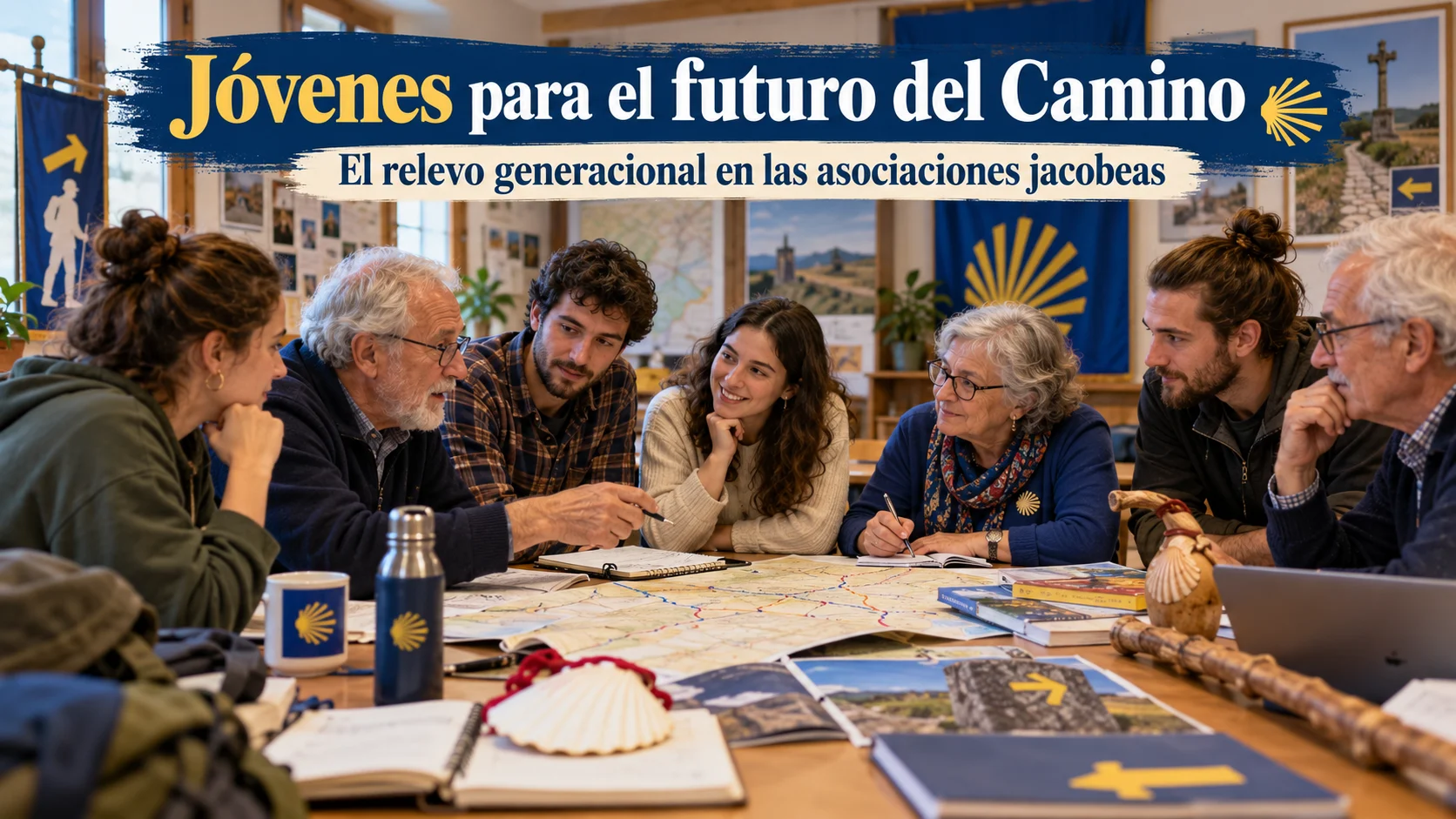
For decades, many Jacobean associations have supported a fundamental part of what we know today as the Camino de Santiago. They have recovered routes, painted arrows, opened shelters, organized conferences, attended to pilgrims, defended heritage and kept alive a culture that did not always have the current visibility. All that work deserves recognition, because without those people the Camino would be very different today.
Precisely out of respect for everything built, the time has come to speak naturally about an important issue: generational change. It is not about separating those who have been working on the Camino for twenty, thirty or forty years, but rather ensuring that all that knowledge is not lost and can be passed on to a new generation.
The experience of the elderly continues to be essential
Those who have been within the associations for many years know the real history of each route, they know how problems have been resolved, they have built relationships with institutions and city councils and they preserve a memory that does not appear in any archive. That experience is not superfluous, on the contrary, it should continue to occupy a central place.
But maybe that place can evolve. Instead of always keeping the same people in executive positions, it could be very useful to create advisory figures, councils of experience or spaces where those who have dedicated half their lives to the Camino can guide younger teams.
That would allow something very important: preserving memory and, at the same time, opening space for new responsibilities.
The problem appears when there is no one behind
Many associations have been operating for years thanks to the efforts of a small group of people. As long as those people remain active, everything seems to work. The real problem appears when fatigue, age, illness or simply the legitimate desire to take a step back arrives.
If at that moment there is no one prepared to continue, the association is left in a very delicate situation.
That is why the generational change should not begin when someone announces that they are leaving the presidency. It should start much earlier, incorporating young people little by little, giving them real responsibilities and allowing them to know how the association works from within.
The young people are already on the Camino
It is not true that young people are not interested in the Camino de Santiago. Every year thousands of young people travel the Jacobean routes, participate in activities, volunteer, share experiences on social networks and are interested in heritage, nature, hospitality and culture.
The challenge is to ensure that this relationship does not end when they arrive in Santiago.
A young pilgrim can later become a hospitaller, a volunteer, a member of an association, a communications officer, an organizer of activities or even president of a board of directors. But for that to happen someone has to open the door.
And that door really has to open.
It is not enough to ask them to run social networks
Sometimes we talk about incorporating young people, but we only think about asking them for help with Instagram, videos or technology.
That's not enough.
If we want them to get involved, they need to participate in the decisions. They must be able to propose projects, organize activities, represent the association, assume responsibilities and have a voice within the boards of directors.
They should also have the right to make mistakes. Nobody is born knowing how to run an association, organize conferences or negotiate with an administration. Those who have experience today also learned little by little.
Relay only works when there is trust.
Today's Camino needs new tools
The Camino has changed a lot in the last thirty years.
Today there are applications, social networks, digital maps, instant communication, audiovisual content and an enormous international dimension. New challenges have also appeared related to sustainability, accessibility, security, overcrowding and coexistence between pilgrimage and tourism.
Associations have to preserve the essence of the Camino, but they also need to understand the present.
There the new generations can contribute a lot.
They can contribute languages, technology, communication, video, design, international projects, new forms of volunteering and different ways of relating to pilgrims.
That does not mean replacing the old with the new.
It means combining both things.
Older people can become the best teachers
Probably the best model is not a breakup, but a transition.
Those who have been working for decades could accompany new generations for a time, sharing contacts, explaining past mistakes, teaching how institutions work and transmitting the history of the association.
That role may be even more important than continuing to hold a position indefinitely.
Because leaving a good inheritance is not just about having done many things.
It also consists of having prepared those who will come after.
We must look for young people where they are
If associations want to attract new generations, they can't just wait for someone to spontaneously walk through the door.
You have to look for them.
In universities, institutes, youth groups, European projects, work camps, volunteers, cultural associations, social networks and, above all, among the young pilgrims themselves.
It would also be interesting to create specific programs for them, with specific activities, training, hospitality experiences or participation in real Camino projects.
It is not necessary for a young person to start out as a manager.
But you do need to feel that there is a possible path within the association.
An association without relief has an expiration date
It may sound harsh, but it is a reality.
An association can have a lot of history, prestige and accumulated heritage, but if it does not incorporate new generations it will end up weakening.
That is why each board of directors should ask itself a very simple question: if in five or ten years some of us are no longer here, who will continue?
If there is a clear answer, it means that the relay is being prepared well.
If it doesn't exist, perhaps it's time to start working on it.
Gratitude and future must walk together
This debate should never become a war of the ages.
It would be unfair.
Those who have been working along the Camino for many years deserve thanks, respect and recognition. Thanks to them we have recovered routes, shelters, signage, meetings, publications, archives and an associative structure that has allowed us to keep Jacobean culture alive for decades.
But precisely for this reason we must think about the future.
The best tribute we can pay them is to ensure that all that work continues.
Let there be young people prepared to take up the baton.
May the associations still be alive in twenty or thirty years.
May there continue to be people willing to paint an arrow, defend a church, open a shelter or help a pilgrim.
The Way is also inherited
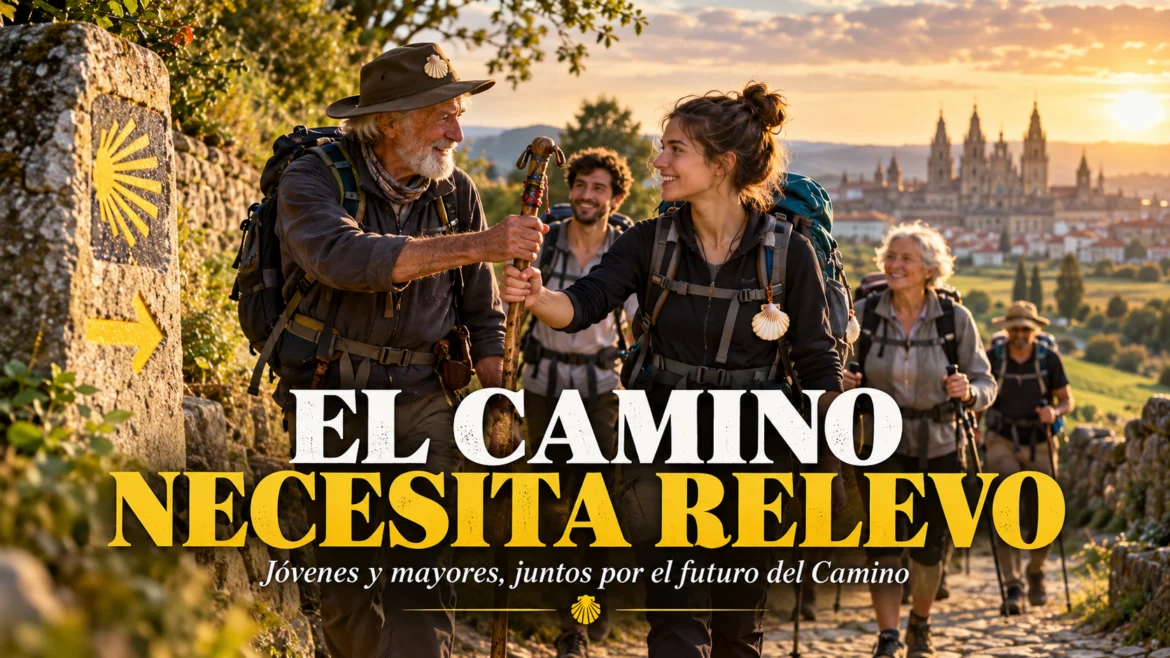
Each generation receives the Way from the previous one.
She takes care of him for a while.
Improve it if you can.
And then you have to deliver it.
That is exactly what should happen within associations as well.
The experience of the elderly must remain, because it is too valuable to lose. But at the same time we need new faces, new ideas and new people willing to take responsibility.
The Camino needs memory, but also the future.
And that future begins when associations are able to look at young people and tell them something very simple:
This Path is also yours, and one day you will have to take care of it.

















