There is no magic number that works for all pilgrims. One of the first questions that arise when someone begins to prepare the Camino de Santiago is how many kilometers they should travel each day. Twenty, twenty-five, thirty... On paper it may seem simple, but the Camino is not walked on paper.
The appropriate distance depends on age, physical preparation, backpack weight, gradient of the stage, time, type of terrain and, above all, previous experience walking for several consecutive days. Traveling 25 kilometers on a Sunday can be relatively easy; repeating them for five, ten or twenty days is something very different.
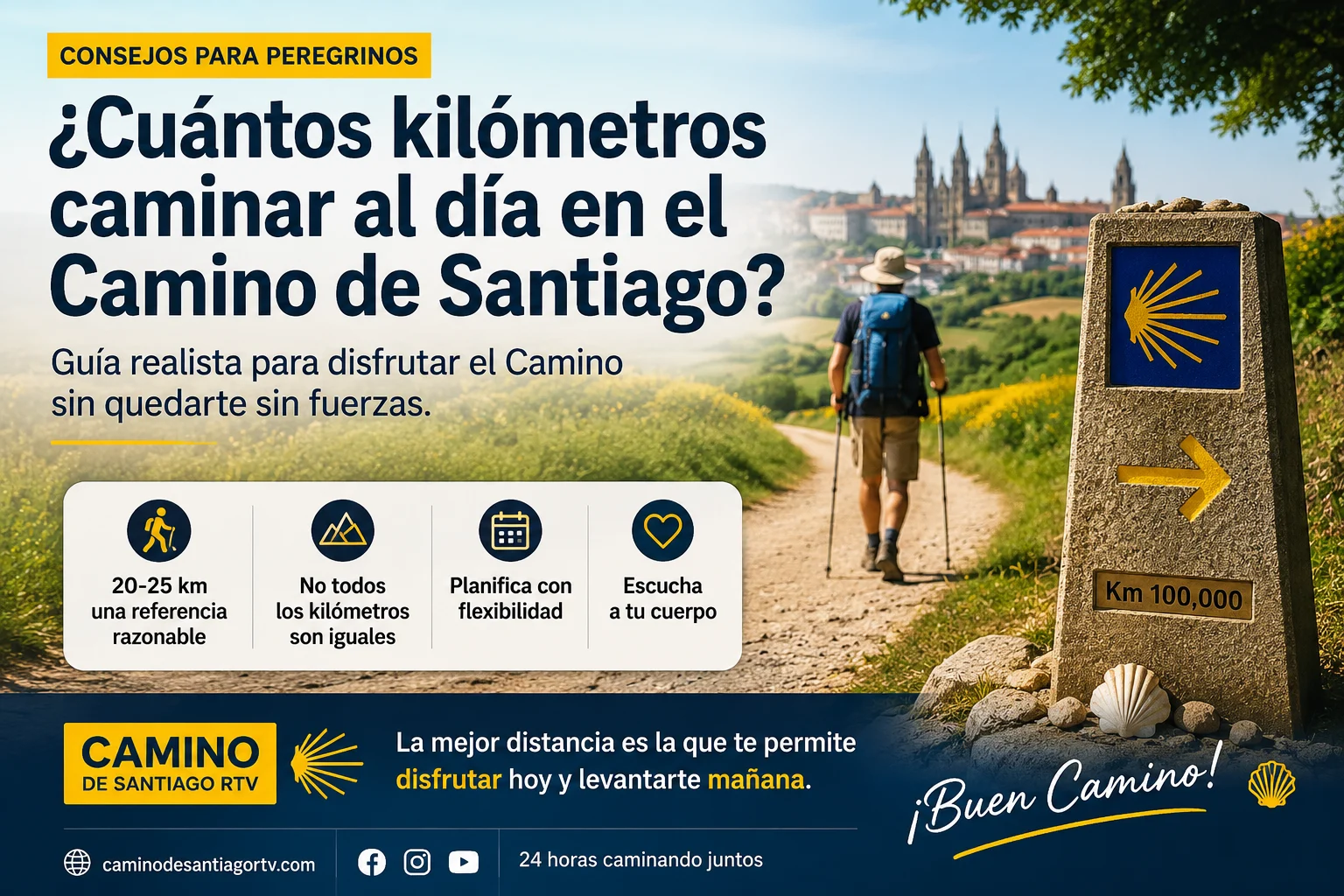
Between 20 and 25 kilometers, a reasonable reference
For many pilgrims on foot, planning approximately between 20 and 25 kilometers daily may be a reasonable starting point. But it should be understood as a reference and never as an obligation.
A pilgrim who makes his first Camino may enjoy traveling 15 or 18 kilometers much more than trying to reach 30 simply because it appears that way in a guide or because other companions advance faster.
The opposite also occurs. Experienced and well-trained pilgrims can complete stages of 30 kilometers or more without special difficulties. The mistake is converting another person's distance into our own measurement.
Not all kilometers of the Camino are the same
Twenty kilometers of practically flat terrain have nothing to do with twenty kilometers of steep ascents and descents. Routes like the Primitive Path They can present physically demanding days even if the distance does not seem extraordinary.
Heat, rain, mud or the condition of the road surface also influence. A day that initially seemed easy can turn into a difficult stage when several of these factors appear.
Therefore, when organizing the Camino it is advisable to look at something more than the number of kilometers: slope, terrain, weather forecast and accommodation and rest possibilities.
The mistake of wanting to fulfill the plan at any price
One of the great attractions of the Camino de Santiago is precisely its ability to break our plans. However, many pilgrims arrive with each day completely closed: accommodation reserved, established kilometers and exact arrival date.
This organization can provide peace of mind, but it can also become a trap if it forces you to continue when the body is asking for rest.
Blisters, overloads, tendonitis and muscle pain may appear especially during the first days. Reducing a stage, resting a few more hours or even stopping for a day does not mean failing on the Camino.
It means listening to the body.
The first days are essential
Those who are not used to walking long distances for consecutive days should be especially cautious at first.
It is preferable to start with moderate stages and progressively increase the distance if the sensations are good. Doing it the other way around—starting with a huge stage taking advantage of the excitement of the first day—can negatively condition the entire trip.
It is also worth remembering that fatigue is cumulative. The body may respond perfectly during the first few days and begin to show discomfort later.
The backpack also adds kilometers
Although technically the distance is the same, walking 20 kilometers with a light backpack does not involve the same effort as doing it carrying too much weight.
Reducing luggage can make a huge difference during a multi-day route. The pilgrim must ask himself if he really needs each object he carries with him.
On the Camino, a few hundred grams seem insignificant when you leave in the morning. After several hours walking, they stop looking that way.
What if I have to travel more than 30 kilometers?
It is not necessarily a problem if there is sufficient preparation. There are pilgrims capable of traveling long distances on a regular basis and enjoying doing so.
The important thing is that the decision responds to our capabilities and not to an improvised competition.
The Camino de Santiago does not award any prize for arriving earlier or for accumulating more kilometers per day.
For those looking to enjoy the landscape, get to know towns, visit heritage, talk with other pilgrims or simply stop to have a drink without constantly looking at the clock, somewhat shorter stages can completely transform the experience.
The best distance is the one that allows you to get up tomorrow
Perhaps that is the simplest rule.
A good stage should not be measured only by the kilometers traveled, but also by how we finish the day and how we face the next morning.
Planning with some flexibility, knowing our possibilities and reserving strength allows you to enjoy the Camino much more.
Because getting to Santiago matters. But how we get there is also part of the journey.