Eating on the Camino de Santiago: an emotionally risky sport
Every pilgrim arrives at the Camino thinking about spirituality, landscapes, disconnection and personal growth.
Lie.
At 1:47 p.m. on the second day you only think about food.
And there he appears.
The legendary.
The mythical
The feared
The beloved.
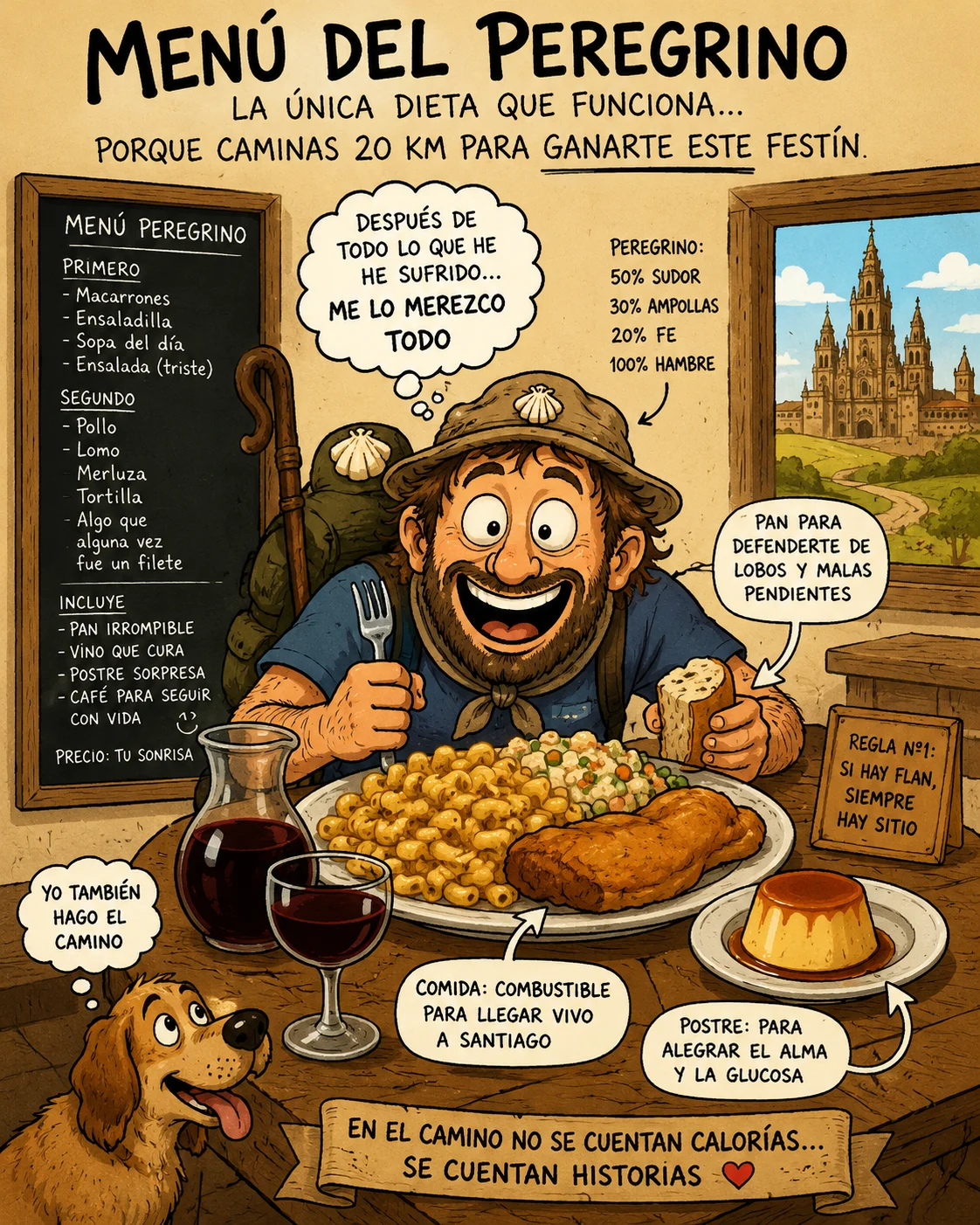
The pilgrim's menu.
That gastronomic concept that unites people from 40 different countries under the same emotion:
“Please let me have a drink, bread and dessert.”
Because if a pilgrim learns something quickly, it is that the body can withstand blisters, rain and back pain... but not survive a 28-kilometer stage while watching other people's snacks pass by.
The hardest psychological moment of the Camino
There is a moment on the Camino more intense than climbing O Cebreiro.
Open the pilgrim menu card.
Because you arrive dead.
Sweaty.
With legs shaking.
With the smell of medieval humanity.
And the waiter looks at you with an offensive calmness and says:
— “First course…”
And you actually want to answer:
— “I don't know… bring me an industrial pot directly.”
But not.
You have to feign dignity.
Then you start reading options.
Typical first dishes of the pilgrim:
- Macaroni.
- Russian salad.
- Lentils.
- Soup.
- Mixed salad.
The mixed salad always appears.
ALWAYS.
Even if you are in the middle of a Galician mountain where lettuce probably hasn't arrived since 1998.
And then comes the real drama:
The pilgrim always chooses wrong
You see “mixed salad” and think:
“I'm going to take care of myself.”
Historical error.
You receive a plate with:
- half onion,
- a sad tomato,
- emotionally destroyed tuna,
- and an asparagus that clearly did not want to live.
Then you look around.
And you see the German at the next table with an Olympic pool-sized plate of macaroni.
And there you understand that you have failed as a human being.
The bread of the pilgrim menu
What a paranormal phenomenon.
Camino bread has unique properties.
It doesn't matter the time.
The town doesn't matter.
The weather doesn't matter.
A loaf of bread always appears capable of breaking an armored window.
There are pilgrims who have used that bread to:
- support mobile,
- level tables,
- strengthen ankles,
- and probably repair a bicycle.
But still...
after 25 kilometers…
you eat it whole.
Because the pilgrim develops a metabolism similar to that of an industrial concrete mixer.
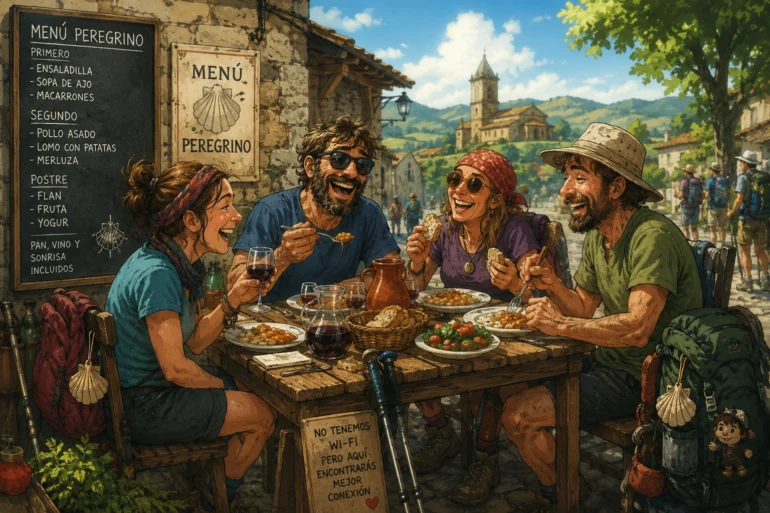
The drink included: the true Jacobean miracle
One of the great international discoveries of the Camino is when foreigners discover this:
— “Is the bottle of wine included?”
And suddenly the Camino stops being spiritual and becomes a European diplomatic meeting.
Italians hugging Koreans.
Brazilians singing.
Canadians crying with emotion.
All thanks to a bottle of strong house wine that could probably clean engines... but on the Camino it tastes like blessed glory.
The drama of the second course
Here we are entering dangerous territory.
Classic options:
- Chicken.
- Back.
- Hake.
- Tortilla.
- Steak with potatoes.
That steak…
which usually has the exact texture of a Roman sandal.
But you eat it anyway.
Because the pilgrim's body loses all critical capacity.
There are pilgrims capable of saying phrases like:
— “Wow, what a steak show.”
While they chew something that looks like a Decathlon shoe.
Dessert: where the happiness of the day is decided
Here the pilgrim reveals his real personality.
Profile 1:
"Fruit."
Balanced person.
He probably does yoga.
He probably has his backpack perfectly organized.
Profile 2:
"Yogurt."
Practical person.
German mentality.
Good financial manager.
Profile 3:
"Custard."
This pilgrim has already accepted the chaos.
He is not afraid of anything.
He probably has three vials and keeps saying:
“Tomorrow I will do 38 kilometers.”
Obsession with calories magically disappears
Off the Road:
— “I can't eat bread at night.”
On the Road:
- bread,
- beer,
- custard,
- paste,
- came,
- rice,
- dessert,
- coffee,
- shot.
And then:
— “I think I'm losing weight.”
Clear.
You have walked up half of Galicia.
The pilgrim breakfast deserves a separate chapter
Because the Camino breakfast has two versions:
Realistic version:
Coffee and toast.
Destroyed pilgrim version:
- coffee,
- juice,
- toast,
- tortilla,
- croissant,
- Neapolitan,
- “just in case” sandwich.
There are pilgrims having breakfast like international truckers at 6:15 in the morning.
And the best thing is that two hours later they are hungry again.
The pilgrim menu creates instant friendships
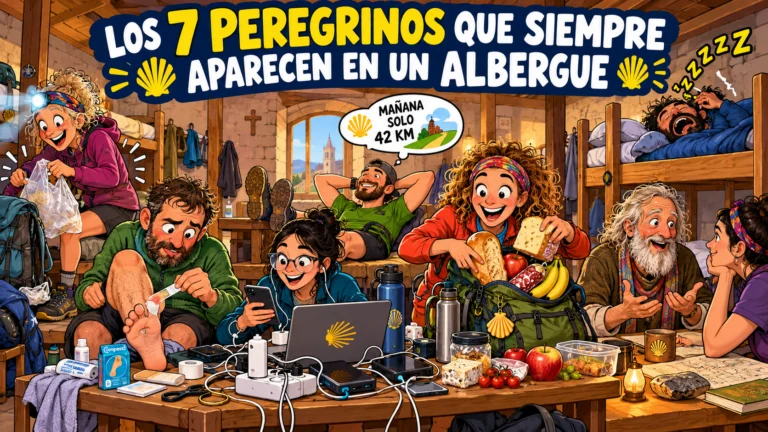
There is no social network more powerful than sharing a table in a hostel.
The language doesn't matter.
The pilgrim's menu unites.
You start by saying:
— “Is this chair free?”
And you end up four hours later talking about:
- divorces,
- blisters,
- spirituality,
- international politics,
- and anti-chafing creams.
The Camino turns strangers into friends thanks to:
- reheated pasta,
- cheap wine,
- and collective leg pain.
The true star of the Camino is not Santiago
It's the waitress who tells you:
— “I can give you a little more.”
THAT PERSON should have monuments.
Because after walking all day, hearing those words produces more emotion than seeing the Cathedral.
The pilgrim's menu tastes better because you are alive
And at the end something curious happens.
Years later you may forget:
- kilometers,
- stages,
- pains,
- or even names of towns.
But you will remember perfectly:
- that brutal sandwich,
- that incredible omelet,
- the Galician broth in the rain,
- or that dinner where you ended up laughing with pilgrims from five different countries.
Because the pilgrim's menu was never just food.
It's rest.
It is refuge.
It's conversation.
It is humanity.
And above all...
It's that wonderful feeling of sitting down dead tired and thinking:
“My God, how hungry I am… and how happy I am.”