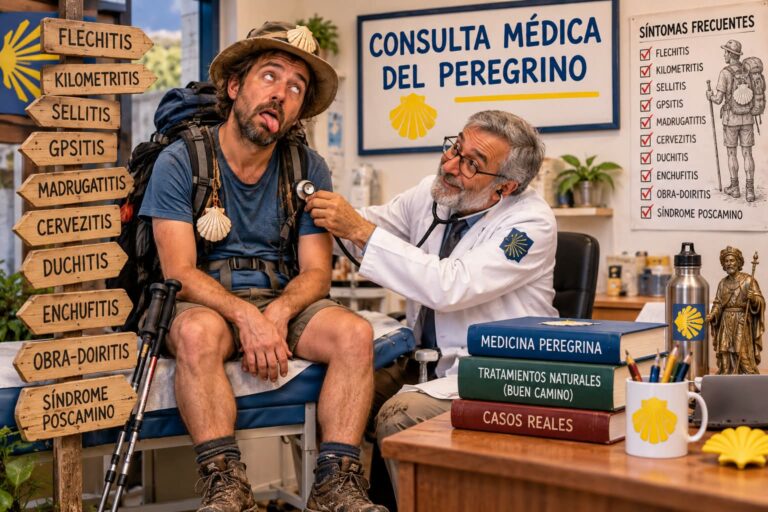
On the Camino de Santiago there is a unit of distance that does not appear on maps: the last kilometer. On paper it measures a thousand meters; on the legs of a pilgrim who has been walking for seven hours is equivalent to crossing a continent. It all starts when someone utters the most dangerous phrase of a stage: "Don't worry, the hostel is already there."
It is a recognizable scene, although deliberately exaggerated in these lines of humor. The pilgrim leaves in the morning with a smile, a perfectly fitted backpack and the conviction that he will not complain today. At noon he negotiated a ceasefire with his knees. And, when he finally sees the name of the town where he will sleep, he discovers that the town is longer than the stage itself.
The 200 meters that defy science
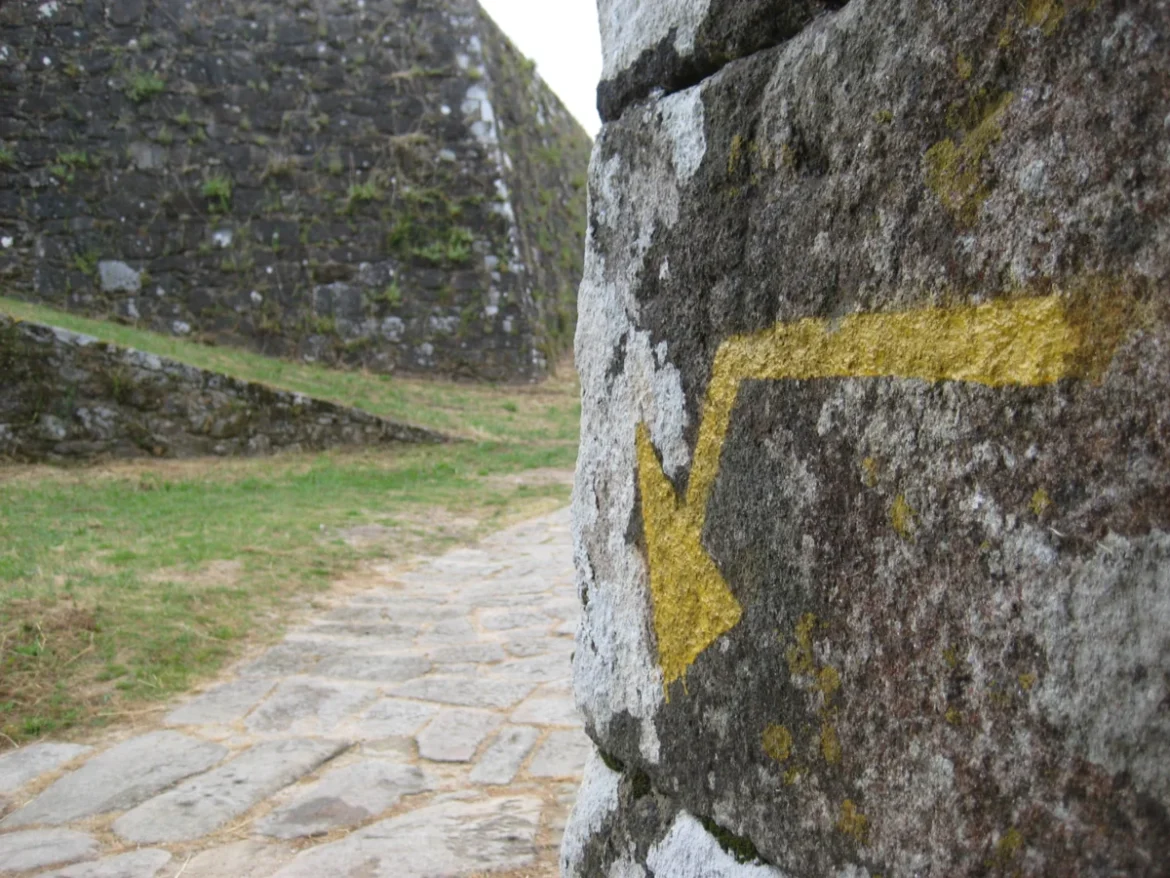
The first sign announces “Hostel: 200 m”. The joy is immediate. He straightens his back, replaces his hat and even appears at a speed unknown since the first day. But the road turns left, goes up a hill, crosses a square and turns again. In the background another sign appears: "Hostel: 200 m."
The pilgrim checks if the arrow has GPS, if the meters are Galician or if someone has invented a metric system exclusively intended to test patience. It's not that the signal is necessarily wrong. The thing is that, at that time, any curve has the psychological length of a highway.
If in doubt, it is advisable to follow official instructions and check the location of the accommodation. The fictional detours of this story belong to humor; real arrows are too important to turn into a practical joke.
The phrase "we are already here" and other threats
Someone always shows up who still has energy. He is the companion who claims to have seen the roof of the hostel behind a hill, although he has probably seen an agricultural warehouse. "Five minutes left," he announces. Five minutes later he repeats the same phrase. Half an hour later no one speaks to him anymore.
There is a particularly delicate moment: when a neighbor appears and the pilgrim asks how much is left. "Nothing, right there," he answers kindly. The problem is that, for a person who lives there, "next door" can mean a pleasant twenty-minute walk. For those who carry two blisters and a backpack that has gone from eight to eighty imaginary kilos, it is a declaration of war.
Meanwhile, the cell phone insists that there are 600 meters left. The clock says it's two. The stomach says it's five. The feet do not issue statements: they have called an indefinite strike.
The celestial appearance of the free litter
And then the secular miracle happens. After the last curve a building appears with a word capable of restoring faith to the most skeptical: "HOSTEL." The pilgrim feels an emotion comparable to arriving in Santiago, but with a fundamental difference: here he can take off his boots immediately.
At reception the most rapid personality change known occurs. Two minutes ago I swore I would never walk again. Now they ask him if he will do another stage tomorrow and he answers: "Yes, but short." The short stage is twenty-four kilometers long and has a profile that, seen from the side, looks like the electrocardiogram of a nervous goat.
After getting a bed, a shower and some food, he discovered that the last kilometer was beautiful. He says it solemnly, looking at photographs taken by others, because during that stretch he only looked at the ground.
El Camino has a sense of humor
The adventure reminds us that fatigue changes proportions. A slope becomes a mountain, a fountain becomes a national monument and a sandwich becomes a mystical experience. Most pilgrims have experienced some version of this tragicomedy and then tell it with laughter.
In fact, when strength is recovered, confidences arrive. Characters appear that seem to have come out of our eight types of pilgrims, words worthy of pilgrim-spanish dictionary and practical solutions like those we collect in tips to avoid blisters.
Of course, a request to those who indicate distances: never promise "two minutes" to a person with a backpack. Tell him twenty. If he arrives before, he will love you forever. If he arrives later, at least you will have reduced the possibility of him dedicating an unkind poem to you.
The true arrival at the hostel is not measured in meters. It is measured in the time it takes a pilgrim to take off his boots, sigh and announce, against all evidence, that he will wake up early again tomorrow.
Text of humor and fictional situations inspired by common experiences of pilgrimage. The featured image is an illustration created for RTV ; Interior photos are actual stock images with credits.